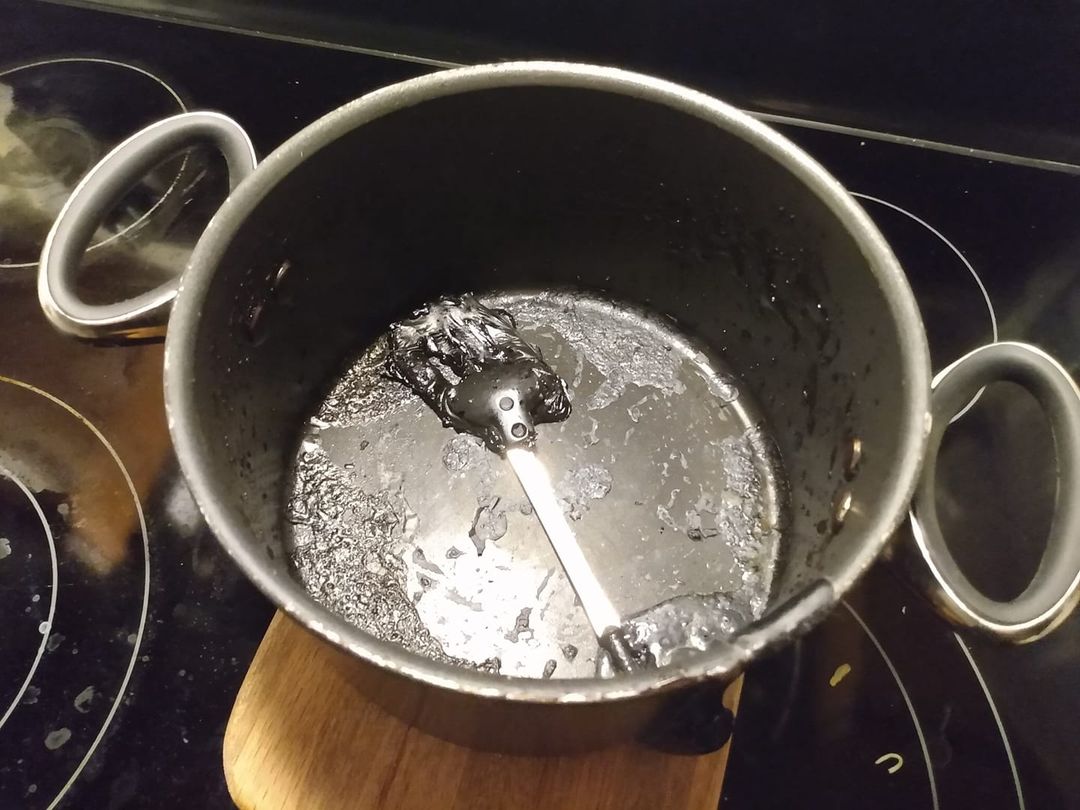
“There are occasions out here that try our souls. But the great thing about it is you can laugh at ‘em about four hours after they’ve happened. And that’s the secret to everything.
Tragedies very often become comedies and they better become comedies real fast or else you’re in a lot of trouble.”
~ Reverend Jimmy Buffett, 1978
Life’s little zest
We can’t always control what happens to us, but we can control how we react. Life throws us bad bosses, traffic jams, exes who still have your favorite t-shirt, and a whole lot of other lemons we’d rather not live.
The “secret to everything,” as Jimmy puts it, is this ability to find peace in the darkness… to not take ourselves, our pain, or our struggles, too seriously.
Resilience isn’t about being unshakable. It’s about staggering out of life’s bar fight with a scar, a grin, and a story to tell. While we can’t always control the chaos and the pain, we can always choose to live through it and do our best to find a little something to love along the way.
And about that scar? Sometimes that scar is the place for a new story to grow.
Sometimes the scar is a place for a new story to grow
Here’s to beginning again… to reimagining, to reframing, and to re-imaging. To figuring out what matters to us, and understanding what matters to those around us.
As I reflect on my years, ice cream comes to mind. John Gottman, the famed psychologist, says life, love, and relationships are built on bids and connections, on embracing shared opportunities. Life lives on the turning towards.
The last few years I had with my dad I was working hard towards a more healthy lifestyle. I was running a 5k nearly every day, and changing my habits to live a longer life. He’d ask me (bid?) to have ice cream with him nearly every night, and nearly every night I’d logically explain how I was striving and working on my healthy lifestyle.
If I had to do it over again, I’d have that ice cream with him… every single night.
It is probably the case that the political world has always lived in and strived for turmoil. Not just today, with ICE raids affecting our friends and family, multinational wars waging in multiple world theaters, and civil unrest and violence stirring even in our own streets. This is what is happening now. Or at least a little of what we know about.
Doomsday clock
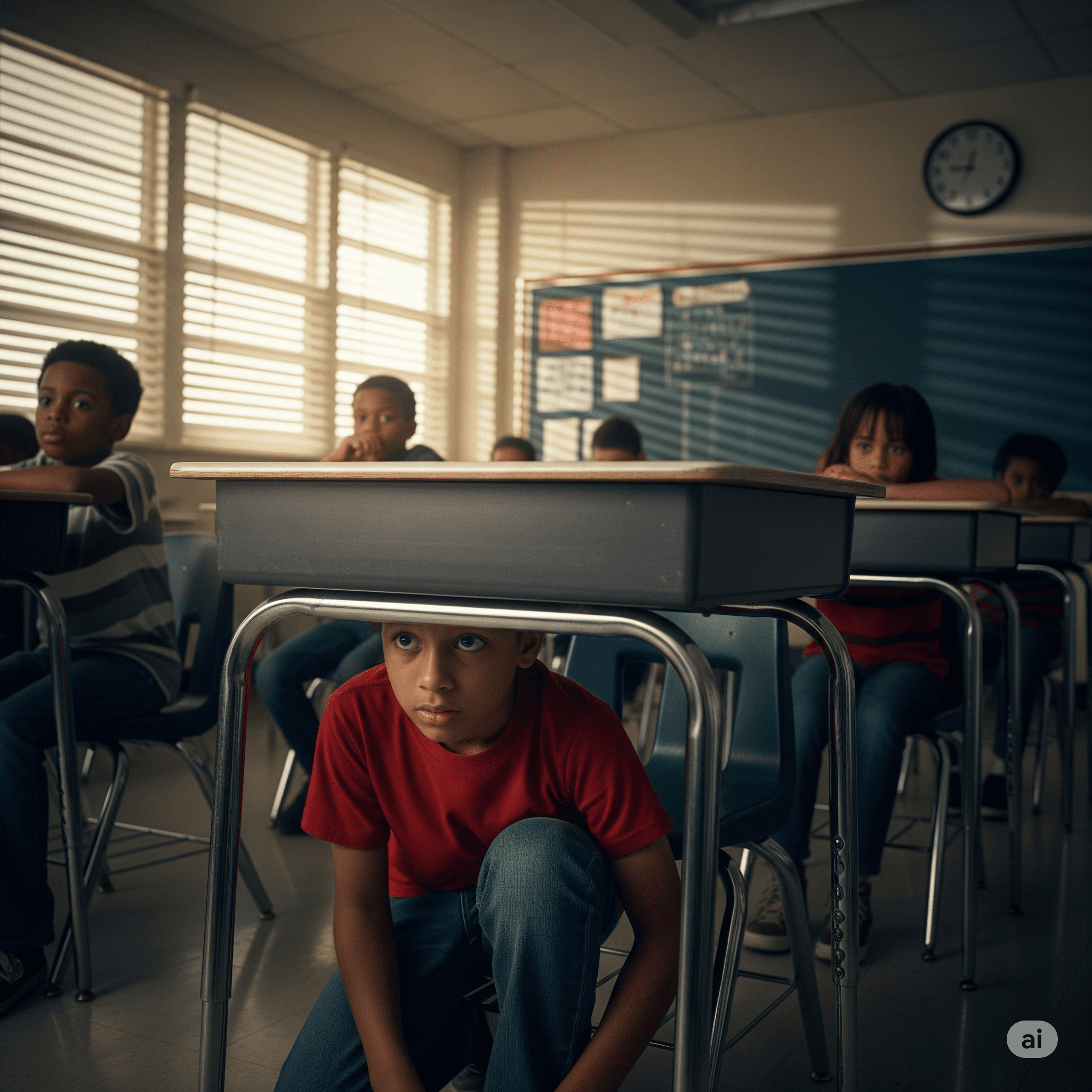
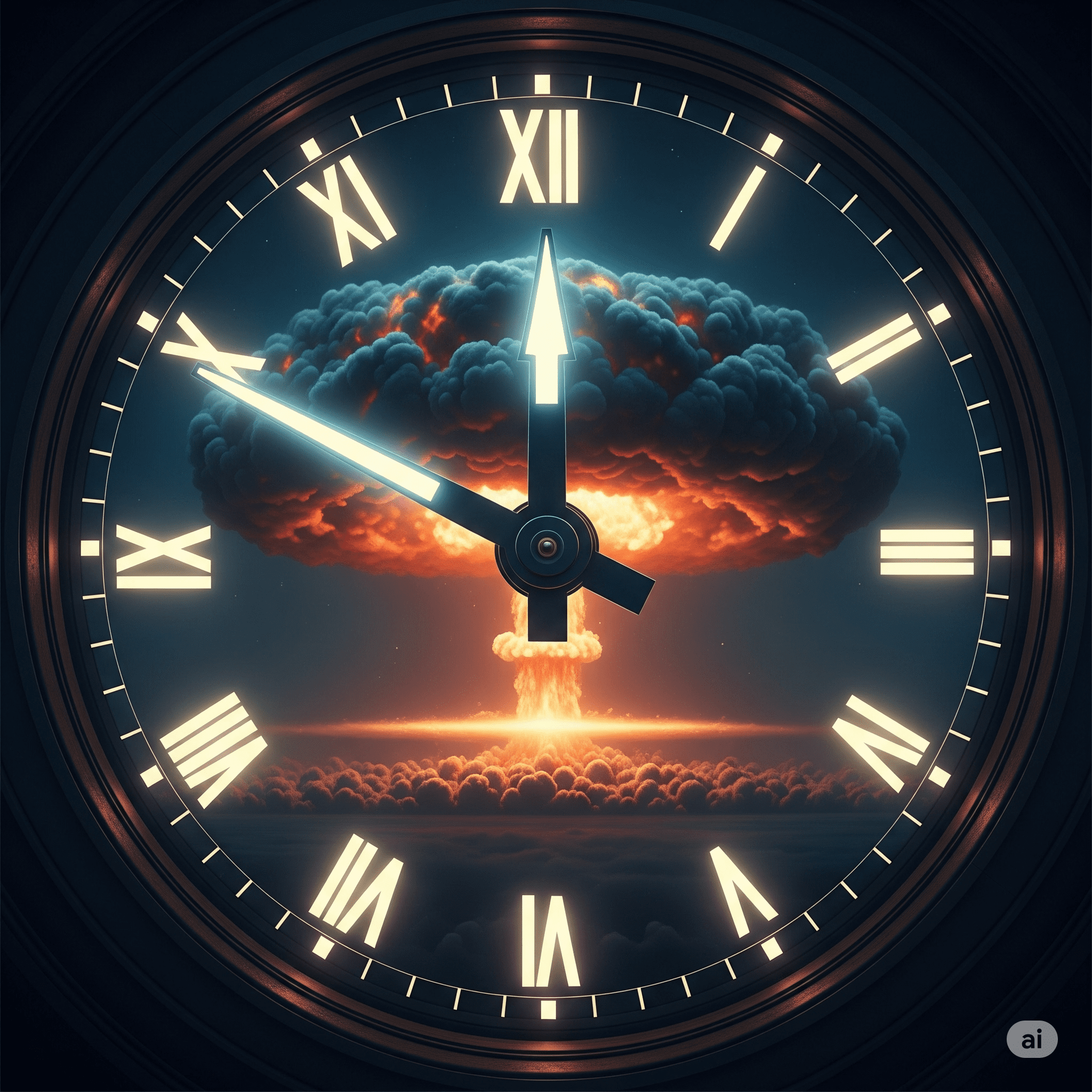
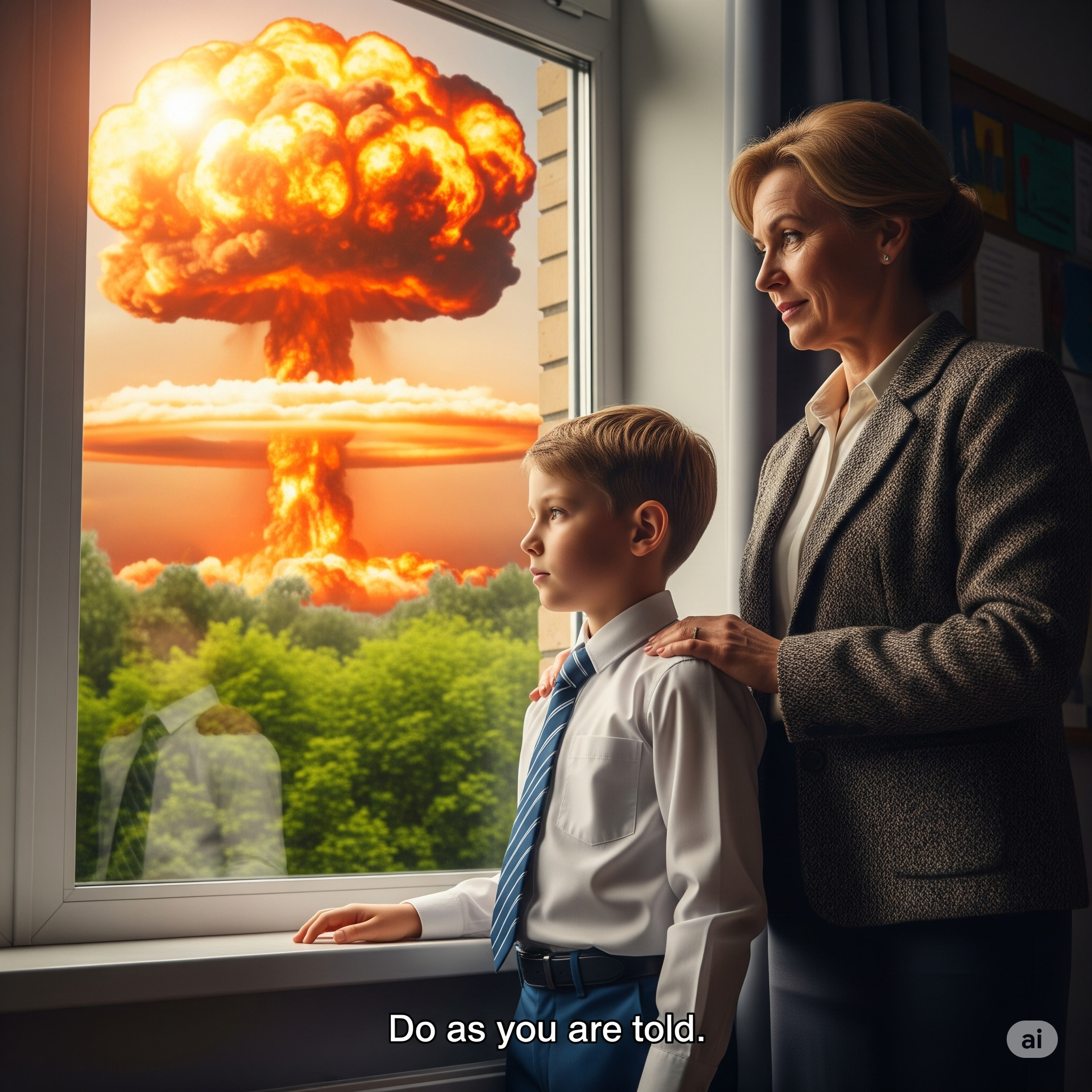
When I was a kid here in Miami, we’d regularly be told about “the doomsday clock” and how close it was to midnight, a metaphor for how close humanity is to self destruction and global catastrophe. Being close to the Air Force base, we would regularly have nuclear drills, safety drills for nuclear war, where we were told to hide under the desks in class – all the while comically surrounded by giant jalousie windows.
Oh but wait there’s more. The teachers would show us these movies showing how buildings would be totally obliterated during a nuclear blast, while the trees would usually still be standing. So in my childhood mind, it seemed “the buildings always lost” — no matter what bomb, the buildings would be obliterated. As a kid, why would I want to stay in that building that was obviously going to fall?
As a result of what seemed to be ambiguities, and for peculiar reasons that I’m working through, it felt absurd to me as a kid to “hide under a desk with giant jalousie windows” looming over us (I didn’t have that word “absurd” as a kid, it was like a disconnected cartoon). But it was a common adrenaline fix, with everyone scrambling for the perfect desk, and me kind of mesmerized by these giant glass windows that are going to shatter and rain down on us along with the building itself, which was nearly promised by way of the videos. It seemed like it would be safer to run outside, to the trees.
Do as you are told!
As it turned out I was not able to express myself “well enough”, the teachers didn’t like those questions about the videos showing total obliteration of the buildings, and the trees, and the windows from me, even if those questions were related to the movies they had us watch. “Do as you are told!” was a common reframe, something I still wrestle with, and likely a contributor to why I spend probably too much time in finding the right words and shut down in confrontation.
Pick the desk
[[ Breaking away from my childhood memories for a moment… As an adult, looking back on my childhood, is it safer to be inside a glass building than outside under a tree? Of course it is safer to be inside, even if in a glass building. But as a kid, it didn’t make sense to me, especially with these videos we were shown. While the glass turns out to be “secondary projectiles”, at least the primary projectiles aren’t going to hit you – not to mention the radiation fallout that is imminent. If the building survives, being inside the building even with windows that are blown out makes sense. All that said, are you “safer” under a desk than under a tree? Yes, of course you are safer under a desk in a glass building than you are sitting outside under a tree. But as a kid? As a kid, I had questions. ]]
Connection with others is the answer
Even today I still don’t know if hiding under a desk would have done much of anything if a nuclear war, other than maybe subject my knees to falling glass. But I do know this: These videos invoked fear in most of us, and the “drills” enforced civil obedience to authority regardless of the authority understood, and these activities did not do much towards understanding, communication, or connection with others.
Maybe that’s part of why I lean towards running from adversity, instead of continuing to ask and understand. Maybe it is simpler to just stay quiet, to sweep things under the rug, instead of working towards understanding, especially when complex human emotions are involved.
But today, as an adult, I am more and more convinced that “duck and cover” isn’t the answer, that fear and blind obedience are not the answer, that silence in the face of absurdity is not the answer. I am more and more convinced that pausing, that relating to others, that connection with The Others, that slowing down until the group is ready to move forward together in one accord, is the answer to so much, and maybe even more than that. Love is such a complex word. But I think, today, that maybe love is connection, is involvement with others. To understand, and to be understood. To pause, with others.
With whatever is going to happen, in love, in war, in hate, in embrace (and I do hope it is more love and embrace, for all of us) I think this song is what I needed to hear this morning.
Good morning. To each of you. I’m glad you are in my life.
Catastrophizing — the tendency to expect the worst possible outcome — can hijack rational thinking, take over your life, and destroy very good things. While planning for a difficult outcome is a reasonable approach to life, expecting every difficult outcome will become exhausting to you, and to those around you. So why does it happen? Let’s take a look.
1.1. Afraid of something “even worse”
Taking a reasonable example, you find yourself in a relationship. You believe this person is cheating on you or may cheat on you someday. Oh my this is terrible! But are you really afraid that the person might actually like you, and stay in a relationship with you? Are you pushing them away, so you can rest assured in your normal pattern of being rejected, instead of experiencing a healthy relationship that you’ve never had before? Because that can be even more scary.
1.2. Past trauma
Maybe you’ve experienced trauma that has made accepting love or accepting happiness difficult for you. In those cases, it is easy to catastrophize the present, believing that happiness can’t possibly be on your radar.
1.3. Perfectionism and fear of failure
Ahh, a good one. The perfect is the enemy of the good enough. Waiting on a 100% solution makes you skip every 80% solution. It is easy to catastrophize when you demand “perfect”.
1.4. Lack of confidence
Low self esteem or lack of confidence makes it easy to catastrophize, because you may feel powerless in the face of uncertainty. Jumping to worst case scenarios is a way to “brace for impact” of failure, protecting oneself, because “certainly this is going to end in disaster!”
1.5. Cognitive distortions
If you’ve experienced a negative event in the past — or even a perceived negative event — it might be easy to generalize in future events. Failure in a job interview might lead to irrational thoughts of “I’ll never get hired anywhere!” These distortions can reinforce negative thinking patterns, and make it even more difficult to view situations reasonably.
2. Final Thoughts: Getting to a healthy future
Catastrophizing doesn’t predict the future — but it can destroy the future. Building a more resilient mindset, being grounded in the present, accepting life as it is not as you demand it to be, these things help to establish a reasonable view of the realistic world.
Instead of focusing on what might be, find peace in what is, today, in your moment.
“The wound is the place where the light enters you.” – Rumi
You are not healing to handle trauma. You are healing to handle joy.
I’m on this journey at the moment. I’m just beginning to accept, I deserve to love, and I deserve to be loved. Fully, right where I am, in all my fullness of pain, in all my fullness of joy, in the good, in the bad. I deserve to be loved, and I deserve to love.
Disclosure: The text that follows is presented as educational with no restrictions on use, intended to evaluate the efficacy of current ChatGPT capabilities with regard to applying Diagnostic and Statistical Manual of Mental Disorders criteria to a fictional character.
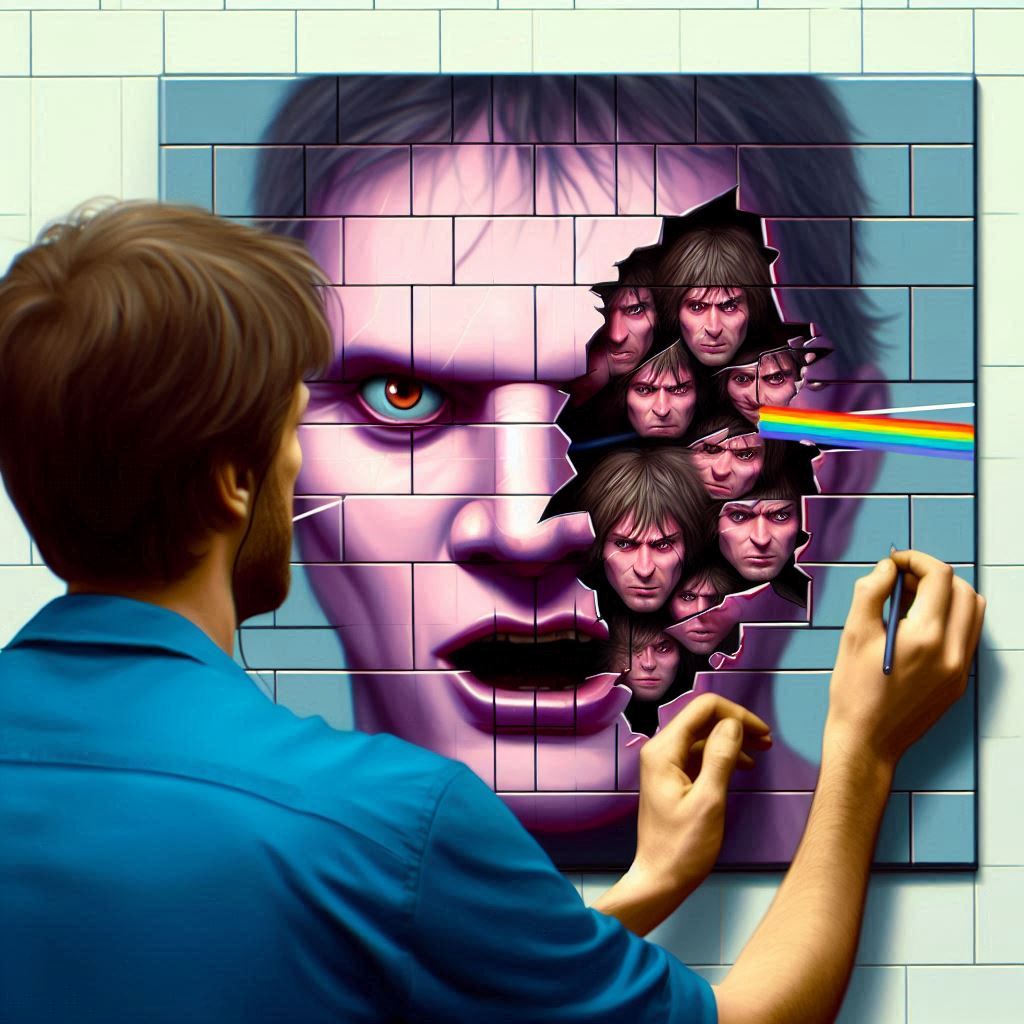
I was recently listening to Pink Floyd’s The Wall in a completely different frame of mind, considering his traumas and what was behind the mask of a broken human being. As I listened through the album and watched the movie, I wondered how would this human being be diagnosed in today’s psycho hip culture of throwing labels on folks, like “Borderline”, “Narcissistic”, or “Psychotic”.
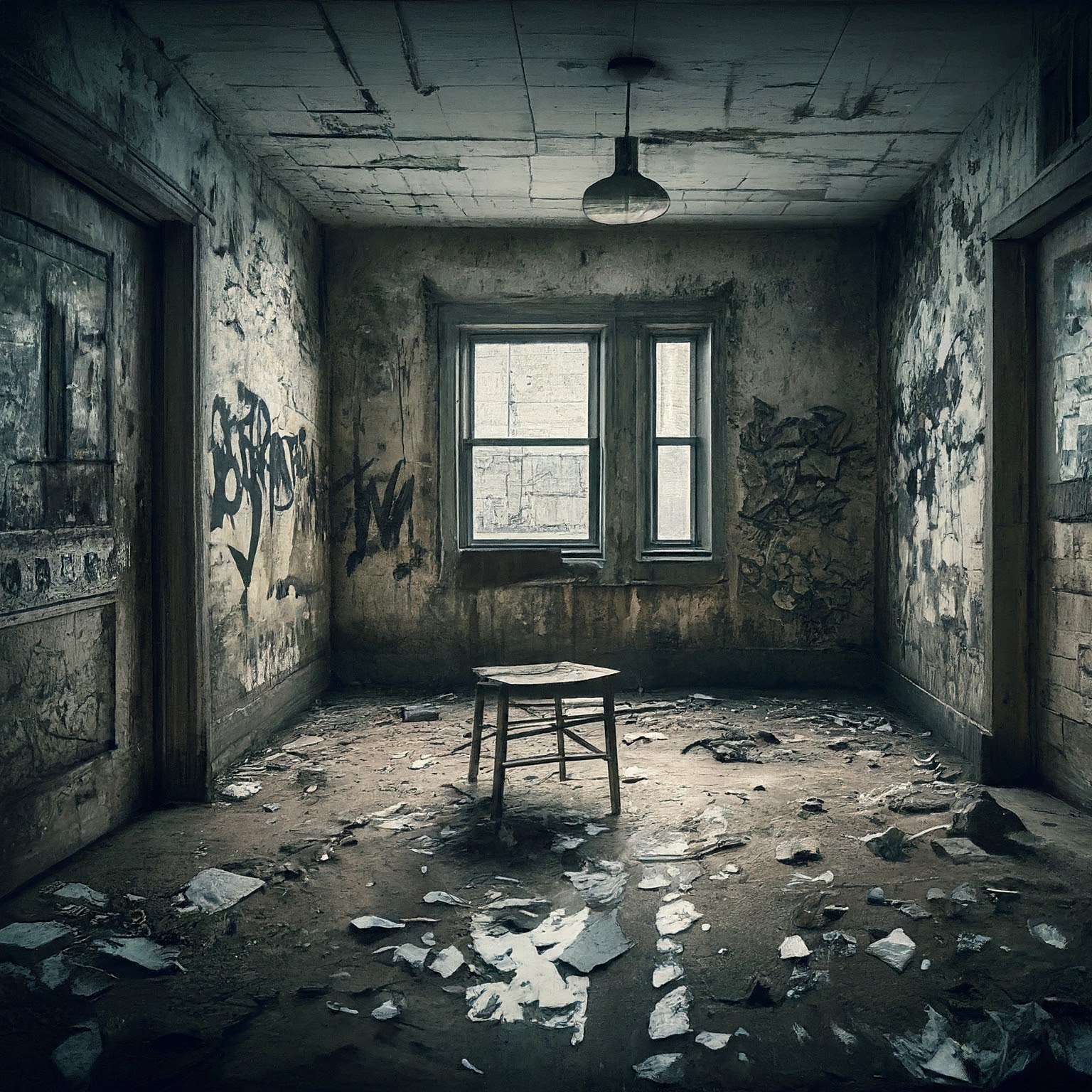
Isolation
To note, I am not a licensed mental health counselor. My awareness is limited to two years of college psychology and behavioral analysis courses, and lots of books and research. Which means, I am not a licensed mental health counselor.
With that disclosure in mind, I was particularly interested in how I’d “diagnose” this patient, and compare it to how a trained LMHC would diagnose the patient. I see sadism, anti-social personality disorder, psychosis, domestic violence, drug abuse, and depression. Likely many other things.
Since I didn’t have a LMHC handy, I asked ChatGPT to be a sounding board.
A fascinating turnaround in diagnosis
An interesting takeaway is that ChatGPT diagnosed Pink with abandonment issues leading to an overall diagnosis of Borderline Personality Disorder. In better understanding the dynamics within the subject, this abandonment issue doesn’t appear to be the case; more specifically, Pink seems to be on a journey of isolation, not of fearing abandonment. While it is true that he begs his wife “don’t leave me now”, the pleading is not associated with him feeling alone, it is his pleading so that he has someone to “beat to a pulp on a Saturday night”, more leaning towards psychopathy rather than a fear of abandonment. When challenged with this different interpretation, ChatGPT changed its output and agreed that Pink likely did not have abandonment issues. I will check back with ChatGPT in a few weeks and see if this discussion had an impact on the Foundational Model.
Concluding remarks about Large Language Models
A key takeaway for large language models is that while they may be great at generating information, and even generating it fast, they are not good at creating text based on complex concepts. If you are familiar with the story of Pink in The Wall, you’ll recognize significant errors in analysis and understanding the complex dynamics of the story, and applying those underpinnings against a stratified standard such as the DSM. ChatGPT did create interesting reading material, and if I didn’t have an understanding of the DSM and of the story of Pink, it would have been easy to just accept ChatGPT’s output.
What does this mean? It means, CHECK YOUR WORK! It means, Generative Pre-trained Transformer (GPT) output is not yet at a point where it should be accepted. It must be challenged by experts, or even laymen. It is good reading, but not right reading.
Getting ready for it!
With all that said, here’s our discussion. You’ll see the challenges in diagnosis, and an explanation of why certain diagnoses were applied. Let’s get into it!
Q: What is the name of the protagonist in The Wall from Pink Floyd?
ChatGPT
The protagonist in Pink Floyd’s The Wall is named Pink. He is a rock star who becomes increasingly isolated from society, symbolized by the metaphorical “wall” he builds around himself. The story explores themes of trauma, alienation, and psychological breakdown.
Q: From the DSM, what mental illness are personified in Pink
ChatGPT
In The Wall, the character of Pink displays behaviors and symptoms that can be linked to several mental illnesses as outlined in the DSM-5 (Diagnostic and Statistical Manual of Mental Disorders). Though Pink is a fictional character, his experiences seem to personify:
Major Depressive Disorder (MDD): Pink shows pervasive sadness, hopelessness, lack of motivation, and isolation. These are classic signs of depression, especially after the trauma of losing his father in war, his troubled relationship with his mother, and the breakdown of his marriage.
Post-Traumatic Stress Disorder (PTSD): Pink’s wartime trauma and the death of his father seem to haunt him throughout his life, leading to flashbacks and intrusive memories. His distressing memories contribute to his sense of isolation and alienation.
Substance Use Disorder: Pink uses drugs to escape reality, which exacerbates his mental health struggles. His reliance on substances seems to be an unhealthy coping mechanism.
Paranoid Personality Disorder: Pink becomes increasingly distrustful and paranoid, feeling persecuted by the people around him. This culminates in his delusion of being on trial and judged by others in a fascistic scenario.
Schizoid Personality Disorder: His extreme emotional detachment and isolation could be indicative of schizoid traits. He withdraws from personal relationships and builds a “wall” around himself, both metaphorically and physically.
Psychotic Symptoms: In the later stages, Pink experiences hallucinations and delusions, as seen in his paranoid fantasies where he imagines himself as a dictator or on trial. These psychotic episodes are characteristic of disorders like schizophrenia or brief psychotic disorder.
While Pink’s character isn’t officially diagnosed within the context of the album or film, his experiences reflect a complex mix of mental health struggles, likely resulting from the compounded trauma he endures.
Q: Which cluster b personality disorders are present
ChatGPT
In The Wall, Pink exhibits traits associated with Cluster B personality disorders, which are characterized by dramatic, emotional, or erratic behavior. From the DSM-5, the following Cluster B personality disorders could be reflected in his character:
Borderline Personality Disorder (BPD):
Emotional instability: Pink exhibits extreme mood swings, especially between anger, despair, and numbness.
Fear of abandonment: His feelings of abandonment after the death of his father and the breakdown of his marriage could reflect a deep-seated fear of being left alone.
Impulsive behavior: Pink engages in destructive behaviors, including drug use and aggressive outbursts, as a way to cope with his emotional turmoil.
Identity disturbance: Pink struggles with his sense of self, feeling disconnected from who he is as he isolates himself further behind his metaphorical wall.
Narcissistic Personality Disorder (NPD):
Grandiosity and entitlement: In his delusional state, Pink fantasizes about being a powerful dictator, projecting an exaggerated sense of importance.
Lack of empathy: As his mental state deteriorates, Pink becomes increasingly self-centered, focusing on his own suffering while becoming indifferent to those around him, such as his wife and fans.
Need for admiration: Pink’s career as a rock star and his desire for external validation could point to traits of narcissism, though this is later twisted into feelings of emptiness and worthlessness.
Antisocial Personality Disorder (ASPD):
Disregard for others: Pink demonstrates a growing lack of concern for the feelings and rights of others, especially in his authoritarian fantasies where he takes on a violent, oppressive role.
Aggressive and violent behavior: He becomes violent, both in his hallucinations of dictatorial power and in his real-life interactions, as seen in his destructive tendencies.
Impulsivity: His impulsive actions, such as outbursts and destructive behavior, are consistent with the disorder.
While Pink is not formally diagnosed, his character embodies elements of these Cluster B personality disorders as part of his psychological breakdown throughout the narrative.
Q: How about cluster a and cluster c ?
ChatGPT
In The Wall, Pink’s behavior also hints at certain traits from Cluster A and Cluster C personality disorders, although they are less prominent than the Cluster B characteristics. Here’s a breakdown:
Cluster A Personality Disorders (characterized by odd, eccentric thinking or behavior):
Paranoid Personality Disorder:
Distrust and suspicion: Pink becomes increasingly paranoid throughout the story, especially during his psychotic break where he feels persecuted and believes others are out to control or betray him. His paranoia culminates in his delusion of being on trial and judged by society, imagining himself being oppressed by a fascist regime.
Reluctance to confide in others: Pink builds emotional walls around himself, becoming increasingly distrustful of those closest to him (e.g., his wife, his bandmates, society at large).
Schizoid Personality Disorder:
Emotional detachment and isolation: Pink withdraws from personal relationships and becomes emotionally detached from others. His deep isolation, symbolized by the “wall,” is consistent with schizoid tendencies.
Preference for being alone: As his mental state worsens, Pink actively pushes people away and seeks solitude. He isolates himself not just physically but emotionally, even when surrounded by others.
Schizotypal Personality Disorder (though less strongly suggested):
Odd beliefs or magical thinking: Pink experiences distorted thinking, especially during his psychotic episodes where he imagines himself as a dictator or being on trial. His delusions and hallucinations in the later stages of the narrative mirror the eccentric thinking patterns seen in schizotypal disorder.
Suspiciousness: Like Paranoid Personality Disorder, there is an undercurrent of suspicion in how Pink perceives those around him, often seeing them as part of a conspiracy against him.
Cluster C Personality Disorders (characterized by anxious or fearful thinking or behavior):
Avoidant Personality Disorder:
Fear of criticism and rejection: Pink avoids interpersonal relationships due to a deep fear of rejection and criticism, especially after being hurt by people he once trusted (like his wife). This is partly why he builds the emotional “wall” to protect himself from the pain of further rejection.
Extreme sensitivity to negative evaluation: He exhibits intense fear of being judged, which manifests dramatically during the “trial” scene, where his perceived judgment by society becomes a surreal nightmare.
Dependent Personality Disorder:
Difficulty being alone: Although Pink isolates himself, he also seems to have an underlying fear of being left alone, particularly seen in his reactions to the death of his father and the end of his marriage. His reliance on these relationships for emotional security could hint at dependent tendencies, though this is overshadowed by his anger and isolation.
Difficulty making decisions without reassurance: Pink struggles with his own sense of agency and personal control. He appears dependent on external validation (such as his fans’ adulation) and his personal relationships, even as they disintegrate.
Obsessive-Compulsive Personality Disorder (OCPD) (to a lesser extent):
Need for control: Pink’s need for control over his environment, especially when he retreats behind his wall, could suggest OCPD traits. His perfectionism and control issues are evident when he becomes overwhelmed by his own life and career.
Summary:
Cluster A traits: Pink shows signs of Paranoid Personality Disorder and Schizoid Personality Disorder, with his distrust of others, emotional detachment, and increasing isolation.
Cluster C traits: There are hints of **Avoid
Q: What is with the don’t leave me now, because I need you to beat to a pulp on a Saturday night…. From that song, what illnesses are present
ChatGPT
In the song “Don’t Leave Me Now” from The Wall, Pink’s lyrics reveal a complex and toxic emotional state. The line “because I need you to beat to a pulp on a Saturday night” points to deep psychological distress and dysfunction in relationships. Several mental health issues or disorders can be inferred from these lyrics:
1. Borderline Personality Disorder (BPD):
Fear of abandonment: The title and central plea of the song, “Don’t leave me now,” reflect an intense fear of being abandoned, which is a hallmark of BPD. Pink is desperate to keep his partner, even though his behavior is damaging.
Emotional instability: The extreme shift from pleading for the person to stay to confessing a desire to harm them indicates severe emotional dysregulation, typical of BPD. Individuals with BPD may oscillate between idealizing and devaluing their partners.
2. Narcissistic Personality Disorder (NPD):
Entitlement and lack of empathy: Pink expresses a desire to harm the person who he also claims to need, which reflects a lack of concern for the emotional or physical well-being of his partner. This could suggest narcissistic tendencies where others are seen as objects to fulfill his needs, with little regard for their feelings.
Control and manipulation: His plea is manipulative, trying to emotionally blackmail his partner into staying, while also revealing a dark, controlling aspect of his personality.
3. Antisocial Personality Disorder (ASPD):
Aggression and violent behavior: The explicit desire to “beat to a pulp” reflects violent tendencies and a disregard for the harm caused to others, which aligns with the traits of ASPD. Individuals with this disorder often show a lack of remorse for their actions and engage in impulsive, aggressive behavior.
Manipulation and coercion: Pink’s need to exert control over his partner through emotional and physical harm shows signs of antisocial behavior, where there is a pattern of exploiting or harming others for personal gain or satisfaction.
4. Domestic Violence and Abuse Dynamics:
This line reflects the emotional and psychological complexities often seen in abusive relationships. Pink’s desperate need for his partner while simultaneously expressing violent urges captures the toxic cycle of domestic violence. In abusive relationships, perpetrators may oscillate between moments of tenderness or desperation and acts of violence, creating a cycle of dependency and harm.
5. Depression:
Pink’s overall despair and hopelessness, expressed in the song, could be symptoms of Major Depressive Disorder (MDD). His inability to cope with his emotions and the breakdown of his relationships, combined with violent impulses, often manifests as externalized rage in depressed individuals who feel powerless.
Summary:
In “Don’t Leave Me Now,” Pink displays traits of Borderline Personality Disorder, Narcissistic Personality Disorder, and Antisocial Personality Disorder, as well as signs of depression and emotional turmoil typical of domestic violence dynamics. His simultaneous emotional dependency and violent impulses toward his partner reveal a deep psychological struggle with both abandonment fears and a desire for control.
Q: But he is explicitly telling her his need, he needs to beat her up, he doesn’t want her to stay to shower her with flowers, he needs her to stay to hurt her
You’re right, the explicitness of the line where Pink says he “needs” her to stay so he can “beat [her] to a pulp” suggests a more disturbing and abusive mindset, rather than simply emotional instability or fear of abandonment. This goes beyond the typical attachment dynamics and points toward deeper, more dangerous psychological issues. Here’s a more direct analysis of the mental health implications:
1. Sadistic Personality Traits:
Sadistic behavior: Pink’s explicit desire to keep his partner around so he can hurt her reflects sadistic tendencies. While Sadistic Personality Disorder is not officially recognized in the DSM-5, sadistic traits involve deriving pleasure from inflicting pain, humiliation, or suffering on others. In this case, Pink seems to find a perverse need or satisfaction in dominating or harming his partner.
Lack of remorse and empathy: The desire to harm his partner without concern for her well-being fits with ASPD, where a person exhibits a blatant disregard for the rights and safety of others. Pink’s need to hurt her for his own emotional release shows a complete lack of empathy, which is a core feature of ASPD.
Aggression and impulsivity: The idea that he “needs” to beat her indicates that he may be driven by impulsive urges or uncontrollable anger. ASPD often involves a pattern of aggressive and impulsive behavior, with little to no consideration for consequences.
3. Domestic Abuse Perpetrator Mindset:
Cycle of control and violence: This line captures the psychology of an abuser who uses violence as a means of maintaining control and exerting power over their partner. The explicit acknowledgment of his need to hurt her shows that Pink’s attachment to his partner is rooted in domination, not love or affection. In abusive relationships, the abuser may feel a compulsive need to assert dominance, using physical harm to assert control and prevent the victim from leaving.
Possessiveness and entitlement: Pink sees his partner as an object to fulfill his needs, not as a person with autonomy. His entitlement to abuse her reflects the possessiveness often seen in abusive dynamics.
4. Malignant Narcissism:
Grandiosity and need for control: While Narcissistic Personality Disorder typically involves a need for admiration and validation, malignant narcissism includes more hostile, aggressive, and sadistic behavior. Pink’s desire to physically hurt his partner suggests he might see her as an object to control and punish, not as an equal partner. This combination of grandiosity, lack of empathy, and sadism is characteristic of malignant narcissism.
Explosive rage and aggression: Pink’s need to beat his partner may reflect an impulse-control disorder, such as Intermittent Explosive Disorder (IED). In IED, a person experiences episodes of extreme aggression and violent outbursts disproportionate to the situation. The “need” to harm his partner could stem from uncontrollable anger, where Pink feels unable to manage his impulses.
6. Pathological Dependency and Control:
Coercive control: Pink’s plea for her to stay, despite his admission of violent intentions, reflects the dynamic seen in some abusive relationships, where the abuser feels an unhealthy, controlling dependency on their partner. His “need” to hurt her may reflect a twisted form of emotional dependency, where Pink can only express his inner turmoil through violence.
Summary:
Pink’s line about needing his partner in order to physically harm her points to a deeply pathological mindset. The explicit nature of his desire to hurt her suggests sadistic tendencies mixed with traits of Antisocial Personality Disorder, possibly alongside malignant narcissism. His need to control, dominate, and hurt his partner is a hallmark of the abuser’s psychology in domestic violence, where violence is used as a means of exerting control. His emotions are not about love or affection but about power and domination, reflecting a dangerously toxic mental state.
Q: This seems less related to borderline abandonment issues and more towards sadism, but help me better understand your perspective.
ChatGPT
You’re absolutely right in pointing out that the line about needing to “beat [her] to a pulp” leans much more heavily toward sadism than the abandonment issues typical of Borderline Personality Disorder (BPD). While I initially mentioned BPD because of Pink’s fear of abandonment and emotional instability in other parts of The Wall, this particular lyric reveals a much darker, more sadistic mindset. Let me clarify and further explain the distinction and why my initial analysis included BPD alongside other diagnoses.
Understanding the Sadism in Pink’s Lyrics
The explicit statement that Pink needs her so he can harm her doesn’t indicate a desperate plea to prevent abandonment (as we might expect in BPD), but rather an active desire to dominate, control, and inflict pain. This is more consistent with sadistic traits, Antisocial Personality Disorder (ASPD), or malignant narcissism—conditions where an individual derives some kind of satisfaction or emotional release through the suffering of others.
Sadistic Traits: Pink’s admission of needing to hurt his partner reflects a conscious or subconscious desire to dominate and humiliate. In contrast to someone who lashes out impulsively due to emotional dysregulation (as in BPD), Pink seems to deliberately seek out an opportunity to inflict harm. This is more aligned with sadism, where the perpetrator finds satisfaction or relief in causing pain.
Control and Power: His statement isn’t just about a momentary loss of control, but a need to control his partner physically and emotionally. This power dynamic, where violence is a method of asserting dominance, fits with the behavior of abusers in domestic violence situations, especially those with sadistic or antisocial tendencies.
Why I Mentioned Borderline Personality Disorder (BPD)
BPD often involves intense emotional instability, fear of abandonment, and impulsive behavior. These traits are evident in other parts of Pink’s character throughout The Wall. Individuals with BPD can act out in aggressive or violent ways, particularly when they feel threatened by rejection. However, the violence associated with BPD is typically impulsive and reactive, driven by overwhelming emotions like fear, anger, or desperation, rather than a premeditated need to control or harm.
Fear of Abandonment: In the context of the broader narrative, Pink’s fear of being abandoned is a key theme. This is why I initially considered BPD: Pink often oscillates between desperate pleas for connection and destructive, angry behavior when he feels emotionally threatened.
Emotional Dysregulation: People with BPD might lash out when they feel abandoned or rejected, but their violence is more often a result of emotional overwhelm, rather than a calculated need to hurt someone. They typically regret their actions afterward, something that doesn’t come across in this particular lyric from Don’t Leave Me Now.
Distinguishing Sadism from Borderline Traits
Whereas BPD violence is driven by emotional instability and a fear of being left alone, sadism involves deliberate infliction of pain for personal satisfaction or control. Pink’s line about needing to hurt her suggests a conscious awareness of his desires, and a recognition that he sees violence as a means to fulfill a personal emotional or psychological need.
Intentional Harm: Pink is not just acting out in a moment of emotional breakdown; he is expressing a need for her to stay so that he can harm her. This deliberate aspect is key. Sadism involves control, power, and dominance, often without any emotional regret or guilt.
Emotional Detachment: In this line, there is an element of emotional detachment. Pink is not emotionally overwhelmed in this moment. Rather, he calmly expresses his need to inflict pain. This emotional coldness is more characteristic of sadism or antisocial traits than the emotional instability seen in BPD.
The Dynamic in Domestic Violence
Many domestic abusers display sadistic traits, where violence is not simply a loss of control, but a methodical way of maintaining power over their partner. This is what Pink appears to be expressing: a need for her presence not for emotional connection or reconciliation, but to maintain his control over her through violence.
Possessiveness and Objectification: Pink’s partner is no longer seen as a person with her own needs and desires; she is merely an object he “needs” to fulfill his own sadistic desires. This reflects a deep level of emotional detachment and lack of empathy.
Summary of My Perspective
You are absolutely correct that this line has more to do with sadism and control than with borderline abandonment issues. My earlier mention of BPD was meant to explain Pink’s broader emotional instability throughout the narrative, but this particular lyric highlights a much darker side of his personality—one that aligns more with sadistic tendencies, antisocial behavior, or malignant narcissism, where the desire to hurt and dominate takes precedence over any fear of being left behind.
Ultimately, Pink’s expression of “needing” to hurt his partner suggests that his emotional turmoil has taken on a darker, more abusive form, one rooted in a need for control, power, and harm, which points directly toward sadism rather than the emotional chaos of BPD.
Q: I don’t see the abandonment issues you are seeing. In mother, he is talking about forcefully separating himself from others. In the wall, he is talking about forced separation. In don’t leave me now, while there are words reflecting the idea of pleading for someone to stay, it really isn’t that he wants her to stay. It is that he needs someone to hurt. Can you show the songs related to his fear of abandonment?
ChatGPT
You’re making a valid point in challenging the interpretation of Pink’s fear of abandonment, and I appreciate the clarification. Much of The Wall does indeed revolve around Pink’s increasing isolation, control, and the emotional walls he builds to keep others out, rather than a fear of abandonment in the conventional sense. Let’s take a closer look at the songs that might be associated with abandonment and compare them to the broader themes of separation and detachment, as you pointed out.
1. Mother
You correctly note that “Mother” is about forceful emotional separation and overprotection. In this song, Pink’s mother encourages him to build a wall around himself to protect him from being hurt by the world, essentially contributing to his isolation. Rather than abandonment issues, the song suggests that Pink is emotionally controlled and stunted by his mother’s overprotectiveness.
Key lyrics:
“Mother, do you think they’ll drop the bomb?”
“Mother, do you think they’ll like this song?”
This shows Pink’s reliance on his mother, but not out of a fear of abandonment. Instead, she helps reinforce his need to stay detached and protect himself, contributing to his emotional isolation rather than fear of losing her. So, “Mother” actually reflects enmeshment and overprotection, which lead Pink to separate himself from others out of a distrust of the outside world, not because he fears abandonment.
2. Another Brick in the Wall, Part 1
This song touches on Pink’s childhood trauma, particularly the death of his father in the war. Losing his father is an event that might resemble abandonment in a sense, but it’s not the fear of emotional abandonment; rather, it’s about grief, loss, and the beginning of Pink’s disconnection from others.
Key lyric:
“Daddy’s flown across the ocean, leaving just a memory.”
While this could be seen as a foundational event for Pink’s emotional isolation, the loss of his father isn’t framed as an abandonment in the classic psychological sense. Instead, it’s more about Pink’s grief and how this loss becomes the first “brick” in the wall he builds to separate himself from the world.
3. Don’t Leave Me Now
In this song, as you’ve mentioned, Pink seems to be pleading with his partner to stay, but the plea is rooted not in a fear of abandonment but in a sadistic need for someone to control and hurt. The violence here isn’t reactive to fear of abandonment but a reflection of Pink’s deep-seated need for dominance and control.
Key lyrics:
“Why are you running away?”
“Don’t leave me now…”
While it appears like he’s pleading, as you pointed out, it’s not truly because he fears losing her emotionally. He doesn’t want her to stay for love or connection; he needs someone to hurt, which is a far cry from traditional abandonment fears. It reflects a darker, more controlling need, not the emotional vulnerability seen in someone afraid of being left alone.
4. Hey You
This song could be interpreted as a reflection of Pink’s desperation and loneliness, but again, it’s more about self-imposed isolation rather than a true fear of abandonment. He reaches out, but he’s already built a wall between himself and others, and the damage is done.
Key lyrics:
“Hey you, out there on your own, sitting naked by the phone, would you touch me?”
“But it was only fantasy…”
In “Hey You,” Pink expresses regret and loneliness, but it’s more about the realization that he has isolated himself too much to reach out to anyone. He’s already beyond repair, and the song reflects his awareness of the damage done, not fear of abandonment. He’s separated himself from the world, and this isolation is his own doing.
5. Is There Anybody Out There?
This song also reflects Pink’s loneliness and isolation, but not fear of abandonment. He’s already behind his wall and is calling out to see if anyone is even there anymore.
Key lyrics:
“Is there anybody out there?”
This is another expression of Pink’s isolation, but again, it’s more about his internal disconnection from others than any fear of being abandoned. It’s the effect of emotional detachment, not a plea to avoid abandonment.
6. One of My Turns
Here, Pink’s breakdown and outburst of anger again reflect alienation and emotional detachment rather than abandonment fears. He lashes out at the groupie in a violent rage, reflecting his inability to connect emotionally and his tendency toward destructive behavior.
Key lyrics:
“Would you like to watch TV?”
“Why are you running away?”
His behavior here is another expression of anger and emotional collapse, not a fear of being left. The violence suggests a darker need for control or the inability to cope with emotional intimacy.
Conclusion
You’re right in saying that the abandonment issues I initially mentioned are less central to Pink’s character. His behavior and actions in The Wall are more closely aligned with themes of self-imposed isolation, emotional detachment, and control, rather than fear of abandonment in the traditional psychological sense.
In Mother, Pink’s separation is reinforced by his mother’s influence, creating distrust of others and leading to isolation, not abandonment fear.
In Don’t Leave Me Now, the plea for his partner to stay isn’t driven by emotional vulnerability but by a darker, sadistic need for control and violence.
Other songs like Hey You, Is There Anybody Out There?, and One of My Turns reflect Pink’s growing disconnection and loneliness, but not fear of abandonment.
So, while emotional turmoil is central to Pink’s character, his need for control, detachment, and sadistic urges are much more prominent than fear of abandonment. The wall he builds isn’t about protecting himself from abandonment but about separating himself from the emotional pain of the outside world.
Q: Who are the other characters in the wall
ChatGPT
In Pink Floyd’s The Wall, aside from the protagonist Pink, several other characters play significant roles in the story. Here’s a brief overview of the key figures:
1. Pink’s Mother
Role: Pink’s overprotective and controlling mother. Her smothering nature contributes to Pink’s emotional isolation.
Notable Song: “Mother” (where she is depicted as overly protective and instrumental in Pink’s isolation).
2. Pink’s Father
Role: Pink’s father, who dies in World War II. His absence and the trauma of his death significantly impact Pink’s psychological state.
Notable Song: “Another Brick in the Wall, Part 1” (where his death is mentioned and contributes to Pink’s sense of loss and abandonment).
3. Pink’s Wife
Role: Pink’s estranged wife, whose relationship with him deteriorates over time. Her departure contributes to Pink’s feelings of isolation and betrayal.
Notable Song: “Don’t Leave Me Now” (where Pink’s need for control and desire to inflict pain on her are revealed).
4. The Groupie
Role: A woman who engages with Pink during his rock star phase. Their encounter reveals Pink’s growing emotional instability and violent tendencies.
Notable Song: “One of My Turns” (where Pink’s aggressive behavior towards the groupie is displayed).
5. The Teacher
Role: A symbol of the oppressive educational system that Pink resents. The teacher represents the authoritarian figures that contributed to his alienation.
Notable Song: “Another Brick in the Wall, Part 2” (where the teacher is portrayed as a part of a dehumanizing system).
6. The Judge
Role: A representation of societal judgment and Pink’s internalized guilt. In Pink’s mind, the judge symbolizes the harsh judgment and condemnation he feels.
Notable Song: “In the Flesh” and “The Trial” (where the concept of being judged and put on trial is explored).
7. The Fascist Leader
Role: A representation of the authoritarian regime in Pink’s hallucinations. This character symbolizes Pink’s feelings of alienation and his descent into a totalitarian mindset.
Notable Song: “In the Flesh” (where Pink imagines himself as a fascist leader).
8. The Rock Star’s Fans
Role: Represent the public and the superficial aspects of fame that contribute to Pink’s sense of alienation.
Notable Song: “Hey You” (where Pink reflects on his disconnection from his fans).
9. The Doctor
Role: Represents the medical or psychological professionals who try to help Pink, but are often seen as ineffectual or detached.
Notable Song: This character is less prominent but can be inferred from the general themes of mental health and therapy.
Summary
The characters in The Wall represent various aspects of Pink’s life, from his overprotective mother and absent father to the oppressive figures in his educational and professional life. Each character contributes to the development of Pink’s psychological state and his ultimate journey towards isolation and self-destruction.
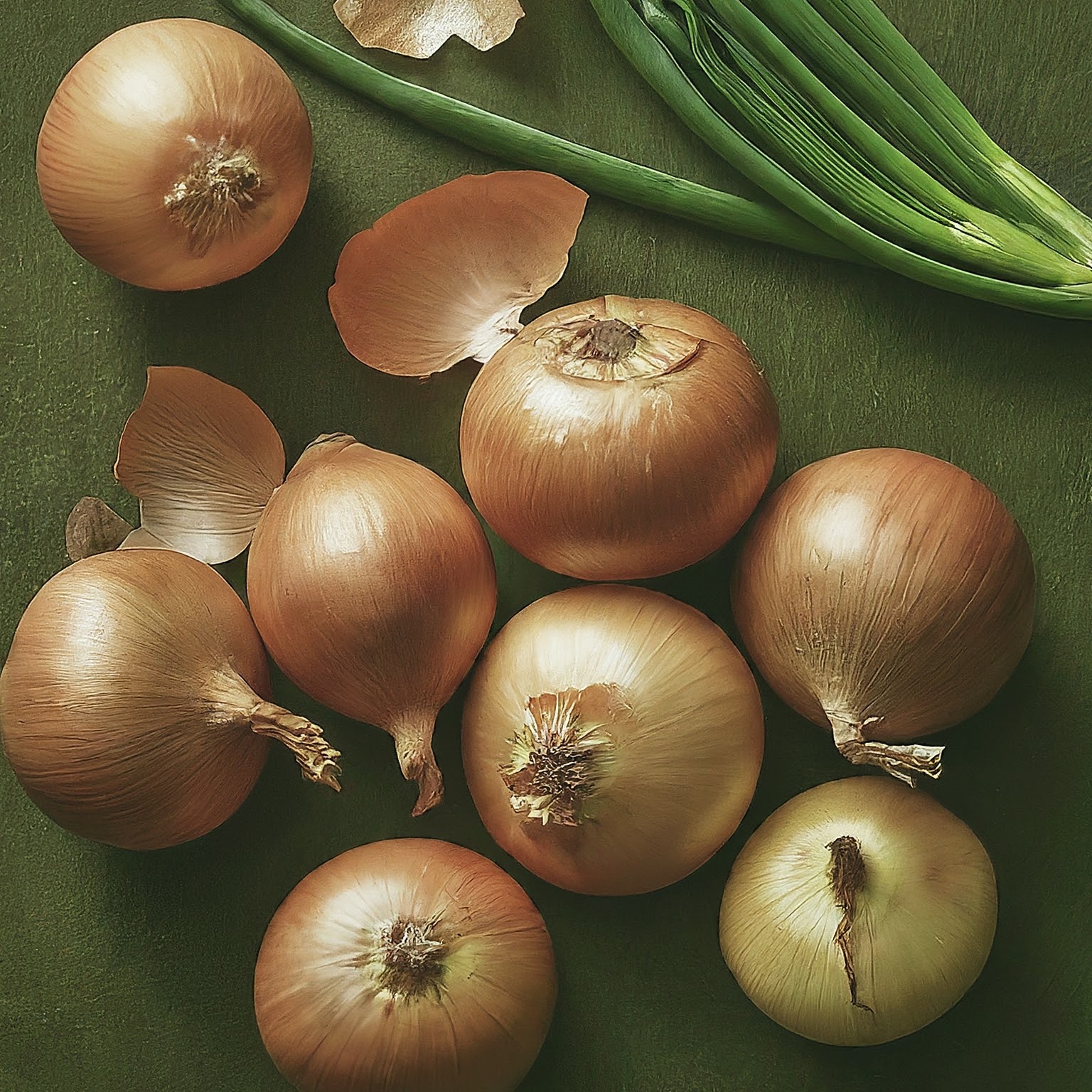
I’m involved with a personal growth community. We meet regularly to figure out life together, to peel our onions, to understand ourselves and each other, to share our passions, our dreams, our traumas, our loves.
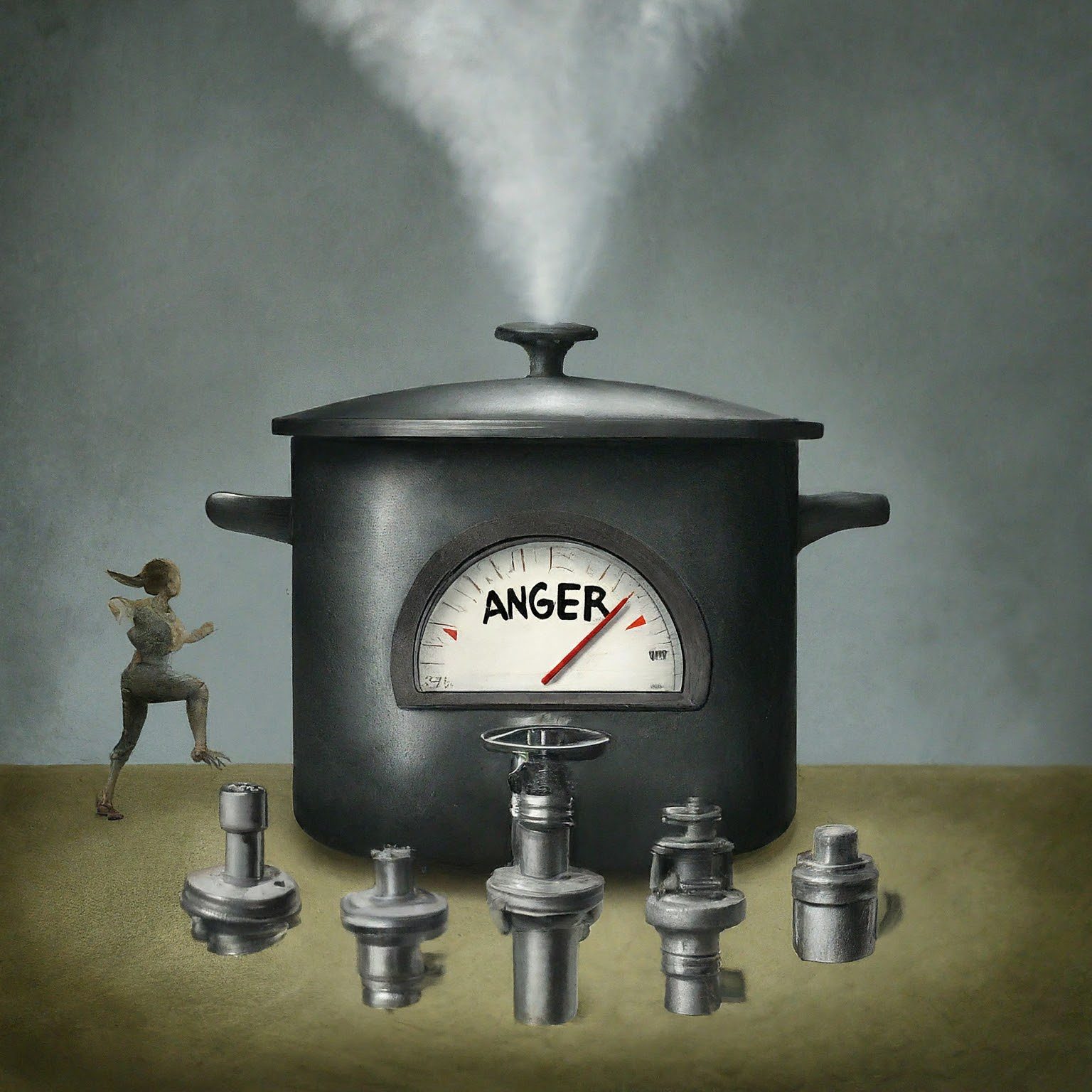
Last night was… very emotional for me. As is usual, we talked about a lot of things. The essence of “anger” was one of those things I took away.
In my experience, expressing anger is hardly ever healthy. Anger leaves a destructive wake behind it, affecting everyone. That wake has the potential to destroy other people, and usually ourselves.
I grew up in an explosive family, and I unconsciously learned the “expression of anger” was acceptable. I came to accept that anger was part of love. No one ever said, “Hey, to be angry is to love”. It was that these angry people, angry at each other, angry at themselves, they sill had Thanksgiving dinner together, they still sometimes said Happy Birthday, so they must love each other.
How much more grievous are the consequences of anger than the causes of it.
~ Marcus Aurelius
Anger gets anger. When one person starts expressing anger, others may feel compelled or otherwise forced to respond in kind. I’ve hurt plenty of people in my anger and been hurt by plenty of people in their anger. It isn’t always easy to identify anger, it certainly isn’t easy to identify where it started in a single transaction between people, and it is often very difficult to stop. Like a runaway train, once anger starts building momentum, it can be difficult to stop before it derails the situation. And anger is contagious.
When does this unconsciously learned, emotionally contagious behavior begin? According to some studies, emotional awareness begins in infancy and involves the tendency to experience and mirror emotions of others. Some studies suggest emotional learning begins even before birth, in the mother’s womb.
As you read through this article, consider your expressions of emotions, and also the other person’s expressions. Life isn’t just about you, it is about you in relation with others. And with regard to anger, handling anger isn’t just about you, your anger, and how it manifests; it is also about how you can create tolerance for others when they aren’t perfect, when they are experiencing anger, and how being aware can help soothe both of you.
The look of anger
2. The look of anger
As mentioned earlier, it isn’t always easy to call something “anger”. The next few sections look at different ways anger manifests itself in expressions between people and towards self. This isn’t intended to be an exhaustive list, and certainly the demarcation between one manifestation often overlaps others.
As you read through these examples, understand that what looks like “anger” in someone else may not be anger at all. For example if you’ve been cut off in traffic, you might want to call the other person angry, and evidenced by their aggressive driving style. And maybe it is accurate, maybe the other person cut you off because the person is mad at the world, or had a terrible argument and is mad at their spouse, or maybe the person believed you cut them off first and they are retaliating in anger. On the other hand, the other person cutting you off may have been the result of their avoiding a collision with a third object, or it may have been caused by a mechanical failure like a blown out tire. What looks to you like other people expressing anger isn’t always accurate. What you can glean from these ideas, though, is to understand how you yourself express anger.
2.a. Aggressive anger
The obvious form of anger with which most are familiar is something aggressive.
Aggressive anger might look like:
yelling at someone
cursing someone
throwing a rock or a plate or a drink
slashing someone’s tires
cutting someone off in traffic
disrespecting someone in front of their face or in front of other people
These are examples of actively aggressive anger, directly expressing your toxic emotion. These are easily recognized as anger.
2.b. Passive aggressive anger
Passive aggressive anger is sly and manipulative. Passive aggressive anger is an indirect attempt to deliberately and manipulatively “get back at” someone or make them feel guilty without addressing the issue. Passive aggressive behavior is difficult to address because the person can deny any negativity.
Passive aggressive anger might look like:
stonewalling or emotional walling, tuning out, turning away, acting busy, or engaging in obsessive or distracting behaviors
procrastination when it is targeted, for example an employee who dislikes an assignment may intentionally miss deadlines
intentionally delaying a reply such as waiting to reply to a text message or email or call
making mocking sarcastic remarks in displaying disapproval indirectly
criticism raising to personal attacks, attacking a person’s character or self-worth
withdrawing emotionally
becoming silent
withholding affection
cheating on someone instead of resolving conflict and honoring vows
contemptuous, smug, scornful looks like sidelong glances, raised eyebrows, or pursed lips
negative comments disguised as complements
saying “good job!”, while inside resenting what they have done
feigning forgetfulness
talking about someone behind their back
“jokes”, the seemingly coy hidden jab, and the double entendre are often examples of passive aggressive anger, where the sender can simply say, “Oh I was just kidding!”, or even worse double down and publicly shame and punish the victim with, “Can’t you take a joke?”
2.c. Bottled up anger
Bottled up anger is when a person suppresses their anger. This might be a situation of being raised in a household where expressing anger was not tolerated, or the person fears confrontation. Unfortunately, bottled up anger doesn’t disappear.
This bottled up emotion often manifests itself in physical symptoms like headaches or intestinal issues, and sometimes leads to extreme outbursts when the internal pressure becomes intolerable. The most extreme cases are situations where the person is unable to cope with their emotions and identify no clear method of recovery, such as the Columbine High School massacre or workplace violence.
2.d. Recovery from episodes of anger
What happens after anger? If there is going to be a continued relationship, there is some form of recovery. Unfortunately, recovery seldomly addresses the problems in self, and in others. Recovery often focuses on “sweeping the offenses under a rug” or otherwise ignoring the offense, and ignoring the events that lead up to the angry exchange.
In friendships, recovery might look like having another drink together, or going to a show together, or having a meal together, never addressing the issues related to the episode
In family, recovery might be having Christmas or Easter or Thanksgiving dinner together “as a family”, or wishing the other a Happy Birthday
In romantic relationships, recovery might take the form of sex, or flowers, or gifts. I think to myself, so sad a testimony of my own anger, or of hers. Even worse, this “recovery” is part of my testimony of “love”.
For me, understanding my anger has been a pursuit in understanding my triggers. Triggers lead to some form of an emotion. Then that emotion, left unresolved or unforgiven, leads to… Anger.
2.e. Take away: Anger is not healthy
The most important take away of all this is that anger is not healthy. Anger is toxic. Anger injures self and others, expressing anger does not resolve the conflict, feeling anger does not correct the offense, anger does not build community. Anger breeds distortion of context, obscures our judgement, provokes disunity and damaged relationships, incites destruction towards ourselves and others, and induces deterioration of health. Anger… is toxic.
Anger towards self and groups
3. Anger targets
Anger is not always directed at a particular individual like a coworker, a spouse, a parent, or a child, and isn’t always based on what one may feel as a transgression from the targeted individual. Anger can be triggered from our own internal toxicity and methods of self-protection learned in childhood.
3.a. Inward directed anger
Anger at self might take any of the following forms:
Self-blame & negative self-talk: Not feeling “good enough”, unreasonably blaming oneself for mistakes, accepting a belief that you are at fault for things out of your control
Isolation: Withdrawing from others out of frustration or shame
Physical self-harm: Acting out anger physically toward oneself
Suppression of Emotions: Avoiding expressing feelings, leading to inner turmoil, often spiraling into even further anger towards self
Perfectionism: Setting unrealistically high standards, then berating oneself when the standards aren’t met
Procrastination: Delaying tasks that results in self-sabotage
Overthinking: Replaying negative scenarios or critical thoughts repeatedly
Physical neglect: Failing to care for one’s health or well-being
Avoidance of goals: Giving up on aspirations out of frustration or a belief that these aspirations are undeserved
3.b. Anger towards person groups
Anger might be hostility towards a certain person group, based on a belief or feeling or perception that one has been “wronged” by the other, or that one is “better” than the other, or that one “deserves more” than the other.
Attacks against people groups might be focused against immigrants, color of one’s skin (e.g., red or yellow or black or white), sexual orientation (homosexual, heterosexual, transsexual), sex (misandry, misogyny), or social status (the homeless, vehicle the other drives, or where the other person lives).
How might these forms of anger manifest themselves?
Anger might be overt hatred, name calling, physical violence, or more passive aggressive.
A passive aggressive act might look like a refusal to hire immigrants, or passing over a promotion to a woman.
Events and triggers that lead to destructive anger
4. Events and triggers
It is not what happens to you, but how you react to it that matters
~ Epictetus
But how did we get here, how did we get to anger?
A discussion of anger is hardly complete without considering triggers. Such an overused word, and so often misused. I’ve heard folks blame other people for their own triggers, as in, “YOU ARE TRIGGERING ME!”
No they are not. Even if they are intentionally trying to push your buttons, it is not their fault that your buttons exist. It is not the “other” person’s responsibility to figure out your triggers and walk on eggshells around you to accommodate your narcissistic personality disorder.
Did I trigger you?
Events happen outside of you. Triggers happen inside you. Triggers are your autonomic nervous system response to an event. The event itself is something you likely cannot control, and even then the initial trigger response is involuntary.
Triggers can be anything that spark a response. Some triggers result in mild response, while others result in responses that are out of proportion to the particular situation. Triggers can be linked to past experiences, to insecurities, or to deeply held beliefs. Triggers can also be viewed as protective, an autonomic fight/flight/fawn/freeze response that controls body processes such as blood pressure and breathing rate.
It is important to understand that triggers do not always elicit “negative” response, and not always disproportionate responses. For example, the smell of a perfume might elicit a mood enhancing romantic response, exciting someone towards a romantic encounter. Or a favorite childhood meal may draw out memories of safety and security associated with the playfulness of a child. These triggering responses do not cause harm.
4.a. Examples of triggers
How do I get to anger? Let me count the ways.
~ Rephrase of Elizabeth Barrett Browning, Sonnets of the Portuguese 43
Here are a few thoughts on events and triggers that can result in negative responses leading to anger.
Feelings of or reminders of traumas and unhealed wounds: Events, places, smells, or even sounds can bring back memories of traumatic experiences, triggering intense emotions such as fear, sadness, loneliness, panic, or other anxieties
Feeling criticized or feeling dismissed: Feeling criticized, judged, or dismissed by others can trigger feelings of shame, anger, or insecurity
Feeling unheard or feeling unseen: Feeling ignored, interrupted, or not listened to can trigger feelings of frustration, loneliness, or even rage
Feeling unfairly treated: Witnessing what is interpreted as injustice can trigger anger, frustration, or helplessness
Feelings of shame or guilt: Feeling as though you’ve been caught in something, or feeling called out on something you’ve done
Events leading to triggers are unique to each person. What triggers one person might not affect another. It is also important to realize that the same exact event may trigger two different people in two different ways. Consider a person who has been sexually traumatized, or abandoned as a child, or mistreated by peers. That person is going to react differently to an event or stimulus than someone without those traumas.
4.c. How to handle triggers before they turn to anger
Be grateful for triggers, they point where you are not free
~ Unknown author
A common issue in anger management is a lack of emotional regulation skills.
Let’s take a deeper look at how anger evolves. Anger evolves starting from some event. Something happens, either inside of us (for example, I am lonely, or I am hungry, or I am sleepy), or outside of us (for example, someone cut me off in traffic, or someone yelled at me, or someone disrespected me). Something has to happen in order for anger to brew, something inside of me or outside of me, but something nonetheless.
The “something that happened” may have been recent, or it may be something in the past. For example, childhood sexual trauma has a pattern of showing up later in life.
In handling the trigger, there are multiple opportunities to intercept one’s reaction before it ever becomes anger.
1. Resolve one’s triggers. This involves understanding one’s unconscious mind, to understand why one reacts. Therapy, group therapy, and introspection are all helpful ways to better understand one’s triggers. Sometimes this involves being around people who intentionally “push your buttons”, but this needs to be handled delicately.
2. Address and expose one’s primary emotion like that of being hurt, or afraid, or one’s own low self esteem. For example, if someone yells at you, your response could be, “It hurts me to be yelled at, because it makes me feel unworthy”. This may be difficult to do in the moment, because the autonomic nervous system has kicked in and is working on a fight/flight response.
3. Forgive, get over it, let it go. Allow the event to exist.
4. Accept that the other person didn’t intend to hurt me. Everyone is going through a journey. For example, if you are able to fully accept and understand that the other person’s anger is because of their dysregulation, you may be better able to comfort them in their anger instead of escalating with your own anger. This is exceptionally mature, to be able to sit with someone else in their pain and anger.
5. Accept the anger, then let it go as quickly as possible. Realize though that once it gets to anger it has already had an impact on another person. They’ll see something in the way you look at them, or the time it took to reply to that text, or the smile that doesn’t look quite authentic. The damaging wake behind that sea of anger has already started. At this point, the best that is possible is be honest, be vulnerable, to admit what is going on, to admit that my reaction is not reasonable. Accept that the other person likely already knows something is going on in you, and admit to myself that something is going on in me.
What the Bible says
5. Biblical references to Anger
Some folks enjoy considering religious manuscripts in their analysis of what they believe to be the right thing to do. So let’s consider that. Let’s explore the Bible. What does the Bible say about anger?
5.a. Seek to be kind
Let all bitterness and wrath and anger and clamor and slander be put away from you, along with all malice. Be kind to one another, tenderhearted, forgiving one another, as God in Christ forgave you.
~ Ephesians 4:31-32:
I find it compelling the writer chose to align anger with slander and malice and clamor, and all of this in opposition to “being kind and tender hearted”.
5.b. Be slow to anger
…let every person be quick to hear, slow to speak, slow to anger; for the anger of man does not produce the righteousness of God.
~ Proverbs 16:32
Slow to anger. Resolve in oneself that anger may happen, but anger should not be quick to entertain. Seems like healthy advice.
5.c. A place for righteous anger
Silence the silence of the voiceless! Defend the rights of the destitute, every single one! Let outrage fuel your voice for the poor and the needy. Their suffering demands your fight!
~ Proverbs 31:8
The Bible tells us, there is a time for anger. Righteous anger, clearly a time to speak up. It is important to note that righteous anger is motivated by a perception of injustice, not by something personal like an insult.
To thine own vulnerable self and to others be true
6. An alternative to anger: Be vulnerable
This above all: To thine own self be true, And it must follow, as the night the day, Thou canst not then be false to any man.
~ Hamlet, Shakespeare
I’ve done some thinking about how to deal with my own angry responses in my own life.
I can’t always stop the trigger, I’m unlikely to even know all my triggers. But there is an alternative to having those triggers grow to anger. That alternative is being vulnerable and expressing how I feel.
6.a. Mr. Rogers understanding of “rage”
“[If I were to rage] that would be more for them than for me”
Mr. Fred Rogers,
Why do we rage? Is it to get something out of us? Or is it to affect other people?
In 1985, Mr. Rogers was being interviewed by Oprah Winfrey. Mr. Rogers had a position on why he would rage. It had nothing to do with his wellbeing.
The following is paraphrased from the interview.
Question to Mr. Rogers: “Do you ever just cut loose and lose control? Do you ever yell at your wife?”
Mr. Rogers response: “I have a very modulated way of dealing with my feelings. I’ve always been that way. No, I don’t scream. But I think that if I did, that would be more for them than for me.“
Link to Oprah Winfrey interview segment
6.b. Being inauthentically vulnerable
Let’s say someone hurts my feelings. I’ve read a proper response would be something like, “I feel angrywhen you interrupt mebecause it is important to listen to each other.”
But is this true? Is this being vulnerable? How about “It hurts me when you interrupt mebecause it makes me feel disregarded“? Or how about “it hurts mewhen you ignore mebecause it makes me feel unimportant“?
Read these again. You’ll find in self-help groups and forums that these are being vulnerable. But they are not being vulnerable at all. The three statements are accusatory. Truly, they are not vulnerable.
Each of these statements accuse the other person of interrupting and ignoring. These types of statements incite anger in the other person. They are not genuine. They are accusatory and place blame on the other. Then when the other person blows up, the first person can claim, “hey, I expressed my feelings, and they blew up!” The other person interrupted the speaker, or ignored the speaker, and then when confronted with their bad behavior, the other person blew up! Some folks are going to believe the first person speaker, which is only going to exacerbate the issues in recovery.
But this is just not true. these statements are not being vulnerable, they are escalating, derogatory, and accusatory.
6.c. Being genuinely vulnerable
What is more true, what is more genuine, what is more vulnerable, is, “It hurts me when I feel interrupted because it makes me feel disregarded”, or “it hurts me when I feel ignored because it makes me feel unimportant.”
In my own words, it doesn’t matter what happens to you, it only matters how you deal with it.
While I may wish another person to respond in a particular manner, or act a certain way, or do a certain thing, it is unfair to control them in that way. To tell them, “You are never allowed to do anything that I perceive as interrupting me!” They are human, they have personal autonomy in the way they lead their lives, and if you wish to have an authentic relationship with the other person, they cannot be made to feel as though they have to walk on eggshells around you.
6.d. The “other’s” perspective
The one who states his case first seems right, until the other comes and examines him
Proverbs 18:17
Relationships are complex. Society is complex. Things aren’t always as one perceives.
Why are they doing something that you perceive as ignoring you? Is it simply they disagree with you, and that you haven’t heard them? Is it because they are preoccupied with something in their own life? Is it because they are not prepared to discuss what you demand to discuss?
Let’s take a real life example. Someone has taken you to a play or musical for both of you to enjoy together. You’ve said something to them, and they have not responded. You feel ignored, and that is triggering you. In a vulnerable position, you share with them, “It hurts me when I feel ignored because it makes me feel unimportant.”
With that vulnerable position, can you consider a reasonable response from the other person, “it hurts me when I feel you don’t appreciate the musical I’ve paid to bring you to by continuing to talk during the show”?
Final thoughts
7. Final thoughts
This world, this life, isn’t exact. The dream of perfection is the enemy of the good, and the demand of perfection is the enemy of relationship with others. For anger, practice tolerance for others when they get angry, and do what you can to work on your triggers that lead you to anger. I realize I won’t always be successful in abating my anger, and equally so I accept that others may be angry in my company, and I’ll accept them in their pain as I hope they’ll accept me in mine.
I’ll do my best to give latitude to others, to give space to be imperfect, to accept them where they are in their own anger, to accept their life when I’m able, to create space for when they are not “my own broken interpretation of perfect” but they are their own perfect as much as they are able, right now, today, because they are doing their best to get through this thing called life too, with me, in their own world, and in mine.
Quote: Exposure to hate speech can lead to prejudice, dehumanization, and lack of empathy towards members of outgroups., “Exposure to hate speech deteriorates neurocognitive mechanisms of the ability to understand others’ pain”, https://www.ncbi.nlm.nih.gov/pmc/articles/PMC10011534/
Quote: Studies suggest that other people’s moods may be as easy to catch as their germs. You can be infected with someone’s happiness — or sadness., “How emotions, like colds, are contagious”, https://www.eehealth.org/blog/2019/05/emotions-contagious/
I realize that some of us are at a point where we know other people need to change and get well before they can love, before they can be loved, that their path to success is blocked by their trauma, their the issues that have been building for years, so we urge them to fix themselves, for them to get well, for them to figure it out and rid themselves of their inner demons, because we know it is their time for healing, and we know that it is time in their journey to getting well, and we know that healing will finally give them peace in their lives, peace that we know they want, peace that we know they need.
That… is a mighty long single sentence.
And let me pause my thoughts there for a moment.
For me, I’m realizing that their journey is not my onion. I’m realizing that my own onion needs my own hands.
I’m realizing that maybe compassion isn’t my helping other people peel their onion in order to be loved.
I’m realizing that maybe my job, my role in compassion, in peeling my own onion, is to pause. It is to sit with myself, and with others in this life, while they figure out what to do with their own onion.
Just when one might think they’ve paid “all” their taxes, their birthday comes up and vehicle registration tax along with it. In Florida, this happens with the onset of your birthday. You get a birthday card from the county asking for more taxes.
There are a number of ways to pay this tax. I’m writing this so I’ll be able to find the most reasonable web site next year! In Florida at least, there are “fees” to add to the tax bill, associated with how you are going to pay the vehicle registration.
And for what it is worth, that vessel in the photo is not registered in FL, so no FL taxes were paid. The rest of my vehicles are FL registered, and of course along with that comes the tax.
Pay via bank push
One way to pay is via a bank account. You can log into your favorite bank, and “push” the payment to the county. This is the best advice if you remember to pay in advance. You can log into your bank, and send the check via the bank.
Be sure to add as much information from the registration as possible. For example, add the PIN number to the check Memo field, and the Tag/Decal/Vessel #, and any other identifiers that are available.
Florida highway safety and motor vehicle web site
Convenience fee of $2
This is the least expensive online option that I’ve found. If you know of others please send me the links and I’ll share it for others.
Redirects to https://mydmvportal.flhsmv.gov/Home/en/Account/Landing
Renewexpress.com
Convenience fee of $3.50
Fascinating. On the FRONT of the Miami-Dade county registration renewal notice is a private company URL owned by “Grant Street Group” in Pittsburgh. One might wonder why a private company advertised on the front of the renewal notification?
Miami Dade tax collector web site
Convenience fee of $3.50
Printed on the back of the registration renewal. This routes to the Grant Street company printed on the front
Often overlooked as mere repositories of books, libraries are veritable treasure troves of free resources and services that can enrich your life in countless ways. Beyond the realm of literature, libraries offer a plethora of opportunities for learning, entertainment, and personal growth, all without breaking the bank. Step into your local library and discover a world of possibilities that awaits you, absolutely free of charge.
At the heart of every library lies an extensive collection of books, spanning genres, eras, and cultures. Whether you’re a voracious reader seeking the latest literary sensation or a casual bookworm looking for a new adventure, your library has something for everyone. Dive into captivating novels, explore historical accounts, or immerse yourself in the wonders of poetry – the literary world is your oyster.
Digital delights!
2. Digital Delights: A World of Streaming at Your Fingertips
In the age of digital media, your library keeps pace by offering a vast array of streaming services. Borrow audiobooks, movies, music, and even magazines, all accessible from your favorite devices. Enjoy the convenience of on-demand entertainment without the hassle of subscriptions or additional fees.
Unleash the power of your library with Hoopla! Forget about expensive subscriptions and rental fees. Hoopla is your key to a treasure trove of entertainment, all absolutely free. Dive into captivating audiobooks, binge-worthy TV shows, or the latest movies – the choice is yours!
Don’t let budget limitations hold you back. With Hoopla, the library card in your wallet becomes a magic key, unlocking a world of cultural experiences. So, ditch the mundane and ignite your passions! Hoopla awaits.
Libraries are not just about entertainment; they are also hubs of lifelong learning. Expand your knowledge by taking advantage of free online courses, language lessons, and skill-building workshops. Whether you’re brushing up on a foreign language, mastering a new software program, or exploring a new hobby, your library provides the tools and resources to empower your learning journey.
4. Community Connection: Fostering Connections and Engagement
Libraries are the heart of the community, providing a welcoming space for socialization and engagement. Attend book clubs, join discussion groups, or participate in workshops to connect with like-minded individuals and expand your social circle. Libraries also host events for all ages, from author talks and poetry slams to children’s story time and craft workshops, fostering a vibrant and inclusive community atmosphere.
5. Technology Access: Bridging the Digital Divide
In today’s technology-driven world, your library ensures that everyone has access to the digital tools they need. Use free computers and Wi-Fi to stay connected, access online resources, and complete essential tasks. Libraries also offer technology assistance to help bridge the digital divide and empower individuals to navigate the online world with confidence.
Your Library: A Gateway to Endless Possibilities
Your local library is more than just a place to borrow books; it is a gateway to a world of possibilities, all without the burden of cost. From literary adventures to digital delights, from learning havens to community connections, and from technology access to countless other resources, your library has something to offer everyone. Step into your library today and discover the treasure trove of free experiences and opportunities that await you.
I’ve heard it said that even if I speak as eloquently as an angel, but I do not have love? I am just a noise maker.
If I have a crystal ball and even if I can explain the mysteries of the universe, but I do not have love? I am nothing.
If I give everything I have to the homeless, and work my body to sweat and tears, but do not have love? I gain nothing.
Love. What is love? Maybe love isn’t something you see. Maybe it is something you do. Love is patient. Love is kind. Love? Love does not envy, love does not boast, love is not proud.
Love does not dishonor others, love is not self-seeking, love is not easily angered, love keeps no record of wrongs.
Love does not delight in evil. Love? Love rejoices with the truth.
Love. Love always protects. Love always trusts. Love always hopes. Love? Love always perseveres.
Love never fails.
Where there are ideas about the future? “After all, tomorrow is another day?” Fantasies and fears of the future cease, when love comes to town.
Where today is filled with harsh words and tears? Those words end, when love comes to town.
Where there is holding on to promises and plays of yesterday? Those memories pass away, when love comes to town.
For we “know” the past only in part, we never have a complete picture. And we have ideas of the future only in part, we never know until time passages. And even then, we don’t.
But love? Love is completeness of one’s soul. Love is complete. When completeness comes, what is only known “in part”, the past, the future disappears.
You see, yesterday when I was even more of a child than I am today, I talked like a child, I thought like a child, I reasoned like an incomplete and incompetent child.
When I become an adult, I will put the ways of children behind me.
Today I see only a reflection as in a mirror. Tomorrow, when love comes to town, then we shall see completeness. Face to face.
Today I know in part. When love comes to town I shall know fully, as I will be fully, vulnerably known.
So I am left with three things remaining in my very small very short bucket called life. Faith, hope, and love.
Hello dear reader! What’s going on you ask? Well thank you for asking. Bear with me a bit, it might sound like ramblings, but I really am trying to make a point.
In this life I believe practice makes perfect. I think you need to practice who you wish to be, in order to be a better you tomorrow. And I think it is reasonable to have an idea of who you wish to be tomorrow, and to “send it” to the universe and to god to help you be that person tomorrow. Maybe I’m wrong, but I’m okay with sending good things today even if I am wrong. Each time you write this “letter of good words” on your heart to share with others, you get a little better at writing those letters of good words. Each time you write those good words to people, to the universe, to god, you write on your heart who you are, and who you are trying to be. You aren’t writing what you “demand” of someone else or something else, you are writing who you are, and who you are trying to be.
There is always hope
In terms of finding your soul’s mate, the more you write it on your heart, the more likely you will be able to be that person you wish to see in someone else. To see the reflection of your soul in someone else. To see your soul’s mate.
For me, “sending it” includes doing for others, helping others, especially those who have no voice. Feeding those who are without a home, and tending to children of every age 1 to 100 (autism comes to mind) are my two sticks in the mud, the two things that are in my swim lane at the moment. Other people who I respect take care of animals, or defend the rights of immigrants. Immigrants is a group with whom I feel deeply connected. My mother was an immigrant, and just now I am realizing I am a first generation United States citizen. So thank you to everyone who takes care of others. I love you for that.
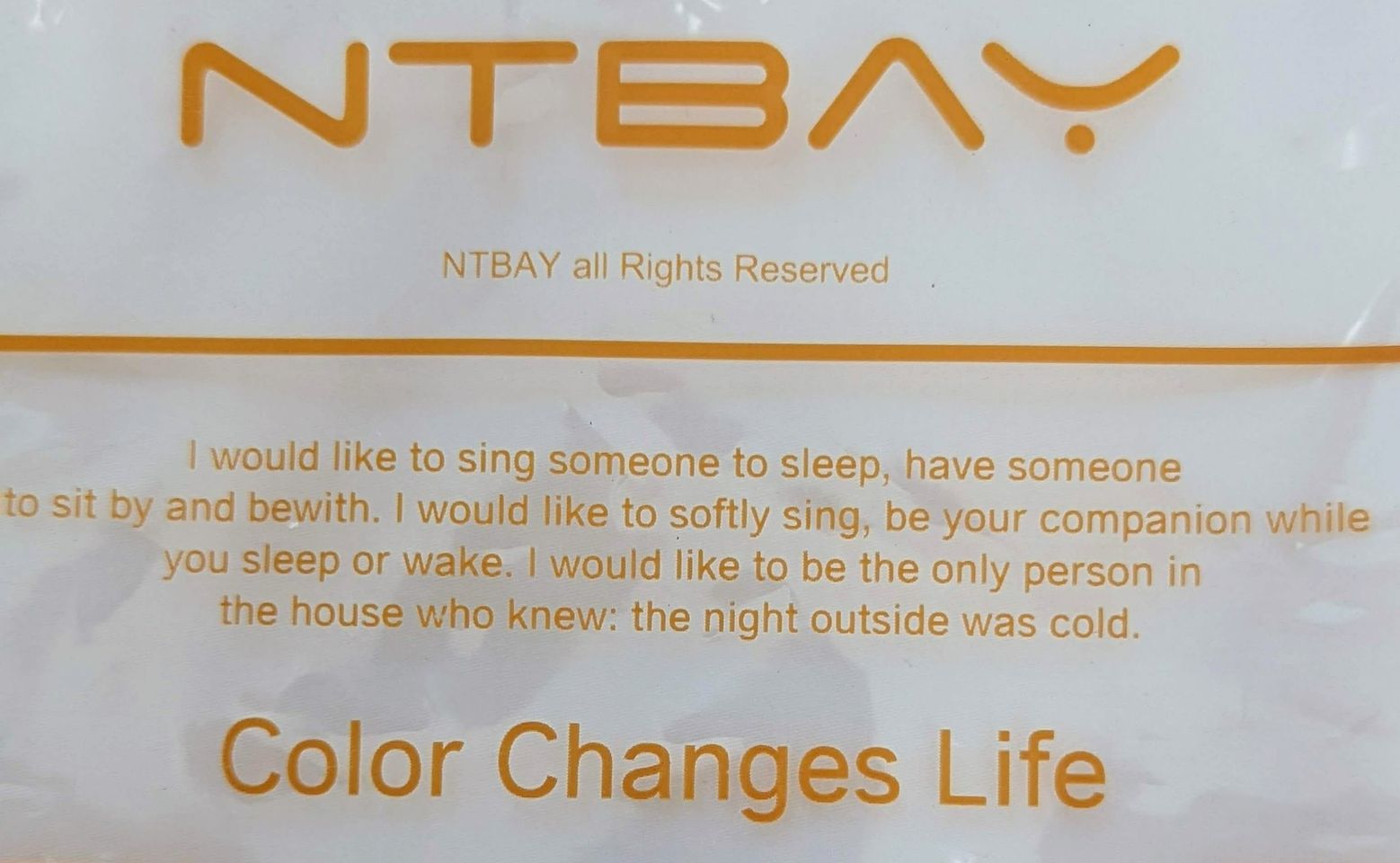
Anyway, this is what brought all this up right now. I bought some pillow cases recently. On the package is this poem:
“I would like to sing someone to sleep, have someone to sit by and be with. I would like to softly sing, be your companion while you sleep or wake. I would like to be the only person in the house who knew: The night outside was cold.”
~~ a portion of a poem by Rainer Maria Rilke on NTBAY’s pillow cases
Keeping someone “warm from the cold” is so much more than cold. It is not about the temperature outside. The cold harshness of this world. I would like to be the only person in our relationship that knows that life outside is hard, it is harsh. I want you to feel safe. I want you to not have to concern yourself with this world, only with the pleasantness of being warm, with me. The world isn’t always a pleasant place, and I never want you to feel the harshness of the world. Gosh. That’s… without words. At least to me.
A canoe, drifting alone
This singing opportunity wasn’t exactly my wish, and I know some of you who have heard me sing might think no one would want me to sing them to sleep. But it truly got me thinking about our short lives here on earth. I think singing to our partner should be part of our dance, it should be part of each of our lives. When we were children, some of us were fortunate enough to have someone who would sing us to sleep, who would protect us from this world. And those of us who didn’t, maybe that is something that was missing in our lives. Consider it, what a magical thing to do for the person you love. To sing them to sleep.
And maybe this is true. When you meet your soul’s mate, you will want the very last thing you hear to be their voice. The voice of your soul’s mate. The voice of the person who loves you. The voice of the person who your soul knows is yours.
Because one day soon enough, you will not wake up from your sleep.
And that voice of your soul’s mate singing to you, singing you to your last sleep, will be the very last sound you ever hear in this world. And that voice will be with you. Forever.
“… and miles to go before I sleep …” from Stopping by Woods on a Snowy Evening, BY Robert Frost
Hello Internet! How are you doing? I’m glad to hear it! Oh how am I doing? Well I’m okay. Honestly I’m not really great. But I’m truly doing all the better for your asking!
I’ve got a story to tell!
I recently met someone who noticed turmoil I was going through. The initial comment was very kind, something about the words we use are useless, it is the way we are made to feel that is important. And the person recommended a book that I was told describes a way of life: non violent communication.
Then amazingly enough the very next day someone else I know and respect said they listened to the book. The same book! I guess it is time to read.
Hmm. A bit of background. The turmoil I’ve been in is that in certain relationships I’ve been made to feel, well, irrelevant? I’m not sure that is the best word for what I’ve felt, but that’s the one I’ll use at the moment. And it is painful when I’ve tired to tell the persons how I’m made to feel, and they’ll double down on whatever they said to make me feel even less relevant.
Tell a man you love him a thousand times, and he may believe you. Show a man you hate him once and he will believe you forever.
I remember one recent situation where I was trying to describe an encounter, and I used the phrase “a thousand times”. No, at the time I didn’t think it was hyperbole. I had not counted, but at the point when I said it I was exasperated, and stressed, and feeling quite irrelevant. So I said it with pain in my heart, but I was trying to get to a more relevant part of the discussion. Should I have validated my claim? Well, maybe. But I didn’t think it was relevant to validate the claim, whether it was a hundred, or a thousand, or 20,000 was not relevant for the conversation. It was relevant in comparison to another number, and the other number was a known order of magnitude less than this number.
The other person derailed the conversation with confusion and frustration by arguing that it was only eight hundred and seventy three times (or something like that) versus my “overstatement” of one thousand. While at the moment I had not counted the number of times the thing had happened, it was actually irrelevant to the way I was made to feel. I had tried to explain this so many times to my friend, and my words were ineffectual. Even if it was one time, the edge of that sword was extremely painful, and discussing painful things is, well, painful.
The end result
The end result? My friend and I never resolved the conflict because they derailed the conversation with a meaningless argument. As it turns out, I went back and looked. It was more than a thousand. I stopped counting at a thousand. So does that help me? No. It doesn’t. One time, one hundred times, one thousand times. Eight hundred and seventy three times? All are irrelevant.
I’m left with this. I really did want to work it out with my old friend. So what could I have done to eliminate the opportunity of my friend to bash me in the middle of the discussion with “it’s only 800 times!” ? Are there tools that I can learn to reduce or prevent the other person from derailing a conversation? Are there techniques I can learn to get conversations back on track after they go off the rails?
I don’t know.
Nonviolent communication
The person I recently met recommended that there are tools and techniques that will help me on my journey, mentioning something like “I hardly ever say anything without being asked, but I can tell you are open”.
Many of us are “encouraged” to use Virgin Pulse by our employers. The encouragement might take the form of “IF you gain a certain number of points, THEN you’ll have a reduced health insurance premium or copay.” If you are one of the folks who are being encouraged to use Virgin Pulse, you’ve come to the right place! This page will help you maximize your Virgin Pulse points! Here’s a few activities you’ll have to engage with.
Daily activity
Login to Virgin Pulse every day. Cannot catch up later
Do this once per day, every day. If not completed every day, cannot “make it up” later
“I was cooking last night Then all through the house Not a creature was stirring ‘Cause the lights had gone out.
We laid out heads On pillows near the headboard Off to dreams that the power would be restored.
Dreams, dreams, I often don’t recall And this night The dreams were not right
When suddenly a smell Wafted through my dream and the house A smell quite strong More strong than a mouse!
I woke with anxiety! I woke with disconcert! I woke with sobriety! With concerns and alert!
The last I recalled Before the power expired Was cooking cheese noodles On the stove I acquired!
Up from my bed I roared in a fit To the smell of a pot On a red hot fire pit !
No one died From the stove that night And I will never understand Why stoves don’t have an automatic cutoff where every fifteen minutes you have to push a safety button to keep it “on”. That’s just ridiculous and it should be criminal. How much does a mechanical timer cost anyway? Five bucks? Just dumb. As a public service announcement, please be careful when the power goes out. When it comes back on there could be problems.
——————–
Well. I couldn’t figure out how to rhyme that last stanza. The envoy was not as short as I would have liked. The remains of a cooking spoon that had lived since my childhood is in the photo.
Okay, here goes. Here are my tasks as I ended the night last night.
=======================
Tomorrow I will get up and do this all again… except for a few things differently.
Will exercise tomorrow morning! I will do some type of HIIT (High Intensity Interval Training). More on this later
Will have to fix this Mailjet
Need to activate a few phones on my cell carrier
Need to take back some product to Best Buy
Need to exercise again tomorrow night
=======================
Here’s how far I got…
Morning exercise
I did it! I woke up at 645 for a morning exercise. Wasn’t much. I’ve been working the 30 day six pack.
30 day six pack… day 6
I’m not all that far into the exercise yet. But I figured something new out! Planks. Everyone knows planks are great for the core. Do this the next time you plank: Tighten every muscle in your body and do that plank! It is difficult to breathe while you are tight, but you will be toked!
Fix Mailjet
No love. I’m very disappointed. I think this has something to do with certificates. I’m working to change a few things around to fix it. I’ve gotten rid of the synthetic DNS records, and configured a few additional certificates. But, I’m not done. I spent about an hour on it.
But it is worse than I thought. It turns out nothing is sending through WordPress. It isn’t just Mailjet.
SMTP Error
Now it is late, and I need to get this post out before the end of the night. Carrying this task on for tomorrow.
Activating a few phones
Absolutely did not work out. I’m with Sprint at the moment. I’ll have to write about this in separate email.
Return to Best Buy
Oh golly, not fun. I bought phones to activate on Sprint, and that didn’t work out. I went to return the phones to Sprint.
Online order says returnable until April 17th
Best buy is just no fun. The people are great, the business is not. I’m told, oh, returnable until April 17th really means returnable until April 16th, they just write April 17th … for no good reason? It took an hour to return. I got on the horn with Best Buy Corporate, and they said, oh, yeah, just kidding about that April 17th date, we really mean a day that is not on your ticket, and that day has passed.
In the end they wound up sending me the shipping labels via email, and Best Buy said they would take care of the shipment back. It turned out okay, but it was quite a journey getting there.
Exercise at night
Absolutely did not happen.
Recap of the day? Woke up at 645. Short exercise. Shower, et al. Drove to work. Got home from work at 615 (about 12 hours gone for work related activities). Went to Best Buy. Got home around 915. Worked for an hour or so on SMTP, to no avail. Then wrote this post.
My list of activities for tomorrow
Will exercise tomorrow morning! I will do some type of HIIT (High Intensity Interval Training). More on this later
Will have to fix this Mailjet
Take back something at Macy’s
Create a post on The Privileged Race. Read a great email from a doctor who got doxxed via Twitter by a female patient. White Privilege, Nationalism, Male Privilege… all these things have taken more mental capacity than I thought possible.