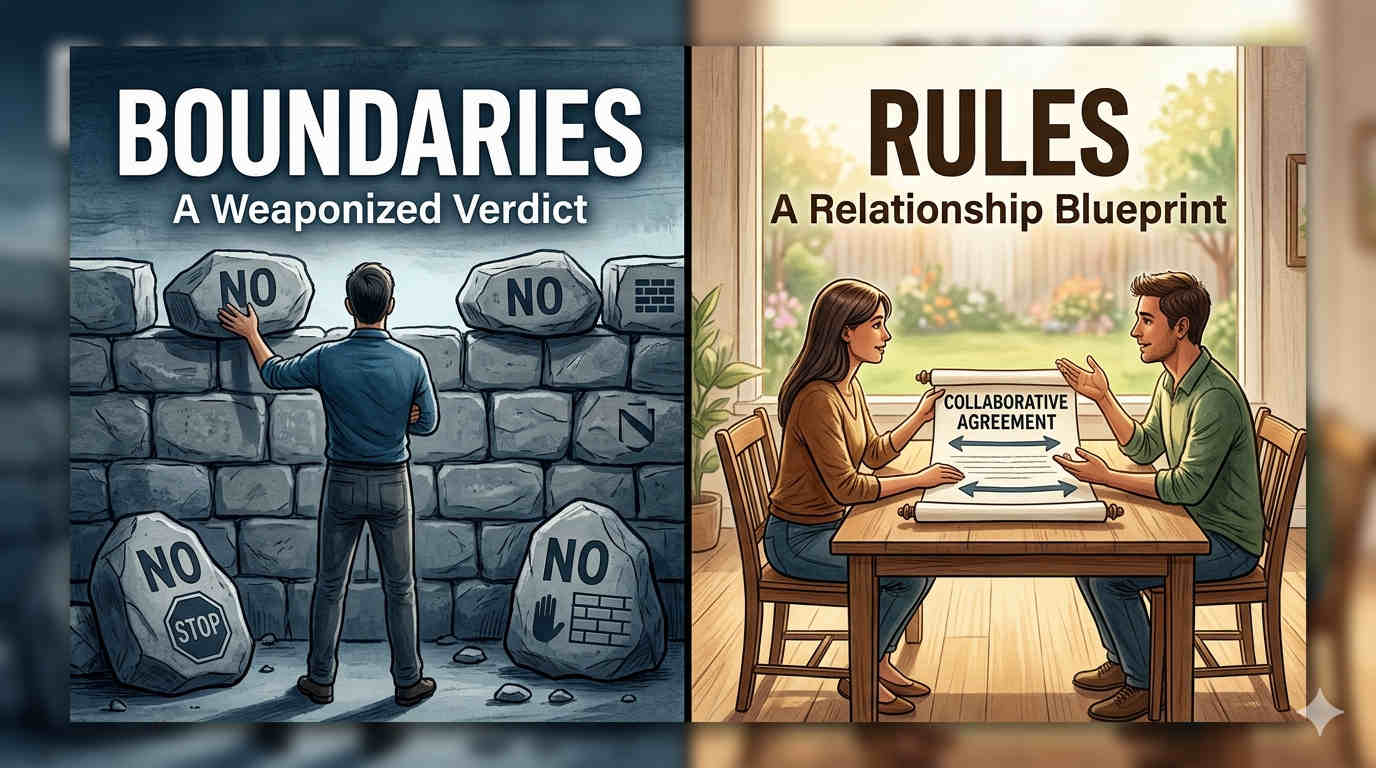
Rules start conversations. Boundaries end them. In a world where therapeutic language has become a tool to avoid accountability, that distinction matters more than you think.
Key Takeaways
- The word “Boundaries” is culturally misused
- Authentic rules are vulnerable and not weaponized
- “My Boundary” is a weaponized power play that results in trauma to the recipient
Somewhere in the last decade, a word escaped from the clinical offices of therapists and landed in TikTok captions, Instagram quotes, self help groups, and even chats among friends. That word is boundary.
In the journey from clinical tool to cultural weapon something got lost, and something nefarious got added.
So lets talk about that. Not to dismiss the real pain that drives people to draw lines in relationships — you are absolutely allowed to have rules in your relationships, and equally so everyone who interacts with you is allowed to have rules in their relationships. Instead let’s talk about this to consider — and reconsider — how “boundaries” are actively damaging to our relationships, to others, and even worse, to ourselves.
What Is A Rule
Rules describe how two people will engage with one another. Rules are bidirectional, and may be either explicitly expressed, or may be implicit.
For example, in platonic relationships, a rule might be, we are not going to kiss each other. But how does that come about? Do you go around to all your friends and discuss whether you are going to have a “platonic rule”? Probably not. But it is there, actively affecting both of you. You might not know the rule is there, but you will definitely know when that rule is no longer there.
In another example, there are work rules. You might need to explicitly be there from 9 to 5, it is agreed to between you and your boss. Or a rule that you have to wear dress clothes.
Another personal relationship rule might be, “I am not going to tolerate the company of anyone who yells, if someone raises their voice I will leave”. That’s a rule. But is it a reasonable rule?
At first it sounds like a reasonable rule, truly, most of us don’t appreciate being yelled at. But the truth of it is that absolutes are hardly ever healthy.
How about if you are at a concert, and someone is yelling at you just to overcome the loud crowd. Is that a time to revisit and negotiate that black and white rule that “if someone yells I will leave”? Maybe you can handle raised voices today and not tomorrow. Maybe your partner needs to express intensity sometimes and the two of you can figure that out together.
Rules live outside of you, where two adults can look at them, whether written or unwritten, where they can be discussed, negotiated, revisited, and revised. That is not a weakness, and that is not surrender. That is what honest reasonable adulting looks like.
What makes a rule workable is that it is situational and discussable. Rules are not claimed to be sacred. Rules don’t end the conversation. They start one.
But Aren’t Those Boundaries?
Here is something worth knowing in the world of words. The researcher most responsible for bringing the word boundary into popular culture defined it in a way that is much closer to rule than most people realize.
“The definition of boundary is simply what is okay and what is not okay” ~ Brene Brown, Rising Strong
That’s it. What’s okay and what is not okay. Brown did not say, my boundaries are what is sacred about me that you must never violate. She didn’t say they are a line that, once crossed, ends the relationship. She said it is simply a practical, discussable list of what works for you at the moment — and your circles of people — and what doesn’t work at the moment.
Even the person most responsible for popularizing this word didn’t intend what the culture is using it to mean.
More importantly, she added something that rarely makes it into the Instagram posts. “When we fail to set boundaries and hold people accountable, we feel used and mistreated. This is why we sometimes attack who they are, which is far more hurtful than addressing a behavior or a choice.”
In other words, in Brown’s own framing, the point is to address a behavior, not to render a verdict about someone’s character. The word was meant to open a conversation, not to close one. Boundaries are meant to be explored, not to judge others.
The character judgment associated with “You broke my boundary!” is never helpful. The vulnerability of “I am hurting by your yelling at me”, is potentially helpful. Somewhere between her research and our culture, the intent has been hijacked.
Conflict Is Real
“Even happily married couples can have screaming matches. Loud arguments don’t necessarily harm a marriage” ~~ John Gottman
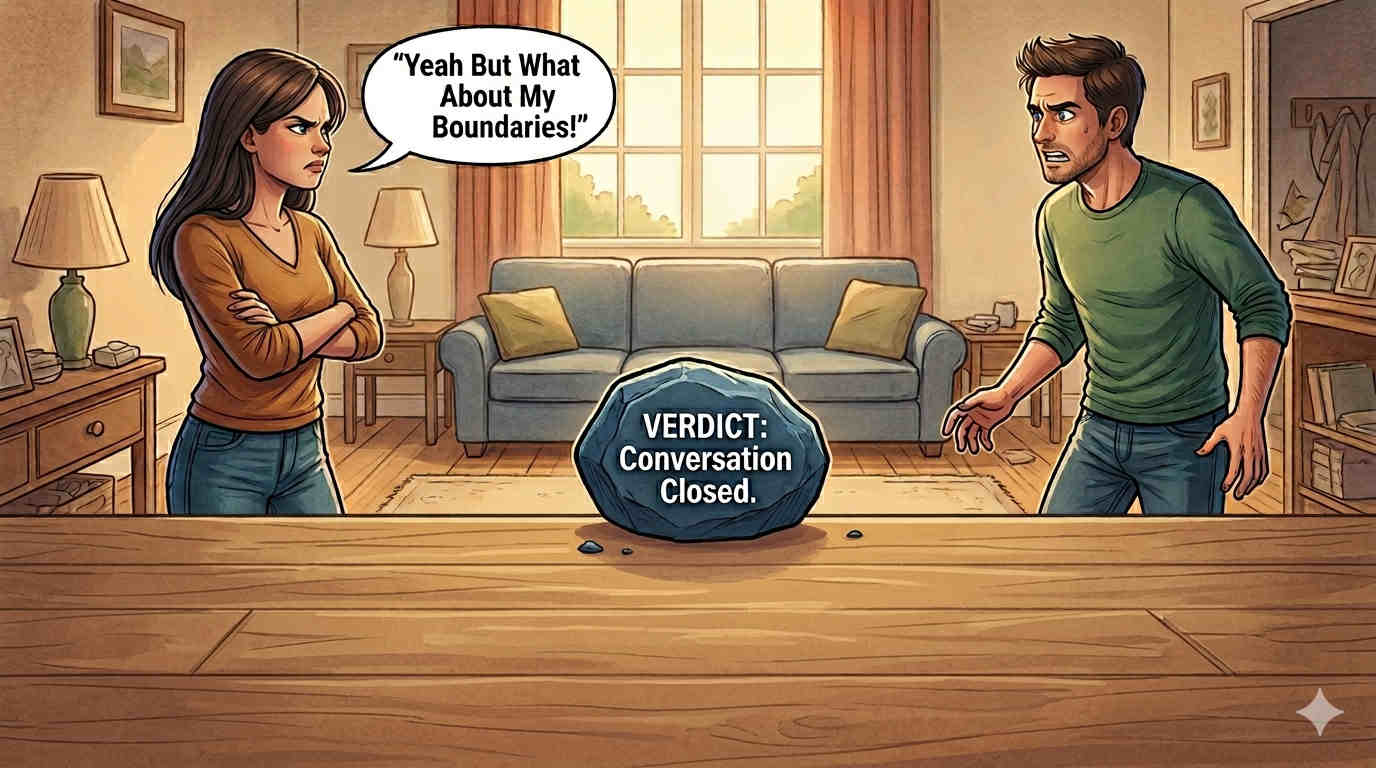
John Gottman, who has spent decades researching what makes relationships last, found that it is not the absence of conflict that predicts whether couples stay together; instead, the predictor of staying together is whether they can repair after conflict. Gottman calls repair attempts the “secret weapon” of lasting relationships. Repair attempts are any statements or actions that prevents negativity from escalating out of control. Those repairs require both people to stay in the room. A statement like “You broke my boundary!” that ends the conversation before repair isn’t protecting the relationship, it is abandoning the relationship.
Maybe “breaking that boundary” isn’t the statement to correct the other person’s actions or behavior, maybe it is the opportunity for the speaker to explore if the boundary is still serving its usefulness.
DARVO: How “Boundaries” Are Weaponized
Here’s where this “Rule vs Boundary” stops being theoretical.
Imagine someone discovers their partner has been unfaithful. They may rightfully be devastated. They are angry, and vulnerable, and broken, and a sea of other emotions. Reasonably, their voice may rise. And in that moment, the partner who caused the harm says, “I can’t engage when you are like this. You are crossing my boundary! I’m leaving.”
Notice what happened. The person who did the damage used therapeutic language to exit accountability. The magic word boundary, which was originally meant to protect the vulnerable (who maybe wasn’t comfortable calling it a rule), has been picked up by the person with power in the room and used to silence the person with no power.
In particular, this rule (or boundary) is an asymmetrical power play. It mimics a moral rule (“Yelling is bad”) to shut down and invalidate the partner’s valid emotional response. It demands that the wounded partner who was cheated on regulate their nervous system perfectly before they are allowed to address a massive breach of trust, even though apparently the cheating partner was not able to regulate their own nervous system to not cheat in the first place.
This is not hypothetical. It happens in homes, in friendships, in small groups, and in churches. How? Because the word “boundary” carries the moral authority of a therapy room. Telling someone they broke your boundary is a classic DARVO move (Deny, Attack, Reverse Victim and Offender).
That same person had the opportunity to say, “I am flooded. I’m not able to have this conversation right now. Can we talk tomorrow?”, which has a similar effect on the speaker, but a completely different effect on the recipient. It is still a rule, but it is also vulnerable, honest, and most importantly it is negotiable. The other person can negotiate back, “I need to talk about this sooner, I have appointments tomorrow, can we talk tonight?” And now two adults are adulting, in a conversation about what each of them needs. It is hard to adult, but it is also real.
Why Ultimatums Fail In The Heat Of Conflict
“If your heart rate exceeds 100 beats per minute, you won’t be able to hear what your spouse is trying to tell you no matter how hard you try.” ~~ Gottman Institute
Pop psychology tells you to issue boundaries mid-argument. “If you keep raising your voice, I am leaving.” It treats a raging human being like a rational actor who is making a conscious choice, where they are now required to perform to your verbal command (which is going to land as a threat).
Gottman calls this state where your heart rate raises above 100 BPM a state of flooding. The body is experiencing a cascade of adrenaline and cortisol, triggering the classic Fight-Flight survival mechanism.
If either party feels as though they are experiencing flooding, they need to be vulnerable and express that they are flooded. However, telling the other person that they are flooded is unlikely to help a situation. To wit, have you ever told your wife, “you need to calm down”?
Transactional Analysis: Who is speaking to whom?
There is a framework from psychology worth visiting called Transactional Analysis, developed by Eric Berne. The basic idea is that in any interaction we are each operating from one of three internal states.
A brief TA primer
- The Parent state is where we store inherited rules, judgements, and “should” statements absorbed from authority figures.
- The Child state holds our feelings, impulses, and early emotional resonses.
- The Adult state is present, grounded, and engaged with what is actually happening, right now. Healthy communication happens Adult to Adult, where all people are present, and equal.
The problem with boundaries is that when someone says, “You’ve violated my boundary!”, they are speaking from the Parent state, issuing judgment and handing down a verdict. The person receiving it is automatically placed in the Child state, being scolded, managed, and penalized.
“This is my boundary” is equally a declaration that others must then obey, and possibly without a defined punitive consequence. Non negotiables are not adult transactions. If you yell I will leave, if you don’t stop crying I will leave, if you don’t calm down I will leave, if you don’t perform, then I will leave.
Consider what we do with children. A parent says, “If you keep crying we won’t get ice cream.” It is a rule designed to control behavior through consequence. The child has no say. Their feelings are treated as the problem to the managed rather than a reality to be understood. Why are they crying? It doesn’t matter, the goal is to stop their crying.
When a person uses language of permanent non-negotiable needs framed as “here’s my boundary that you cannot break”, they’ve created the same Adult to Child dynamic. One person holds all the power, while the others have no power. That is not an Adult communicating their needs with another Adult. It is not a relationship, it is management.
Creating Trauma Through “Boundaries”
When anyone invokes “Boundaries” as verdicts rather than naming needs, the other person experiences the same helplessness associated with every Trauma. They are forced to monitor their own emotional expression, they learn that certain feelings such as anger, grief, intensity, and expressing their own needs are not allowed. Over time, they disconnect from their own interior life in order to stay safe in the relationship. They stop knowing what they feel, because feeling things has been identified by the other as the problem.
“But what happens is if, for the sake of fitting in with the family or with a culture that doesn’t particularly support our authenticity, we have to give up our connection to ourselves, our authenticity, for the sake of attachment? Then being inauthentic, being out of touch with ourselves, is how we survive. We’re afraid to be ourselves because we associate being ourselves with a threat of being rejected. And so this means that for the rest of our lives, we’re going to be in relationships where we’re afraid to be ourselves, to really say what it feels like for us.” ~~ Gabor Mate, MD
According to Mate, when we learn that expressing ourselves honestly costs us safety in relationships, we learn to suppress our feelings for the sake of retaining the relationships around us. That suppression doesn’t just damage the relationship, it damages us. It is a form of self betrayal that has real emotional, physical, and relational costs.
Invoking “boundaries” as a moral compass for self ends up as a weapon to silence and manage others.
What Adulting Looks Like
We all have rules that express needs, and preferences, and limits, and you and I are allowed to have these rules!
But naming them honestly, your needs, your vulnerabilities, as rules, as real, and as discussable things, that opens conversation, rather than encoding them in language that ends the conversation is critical to Adulting.
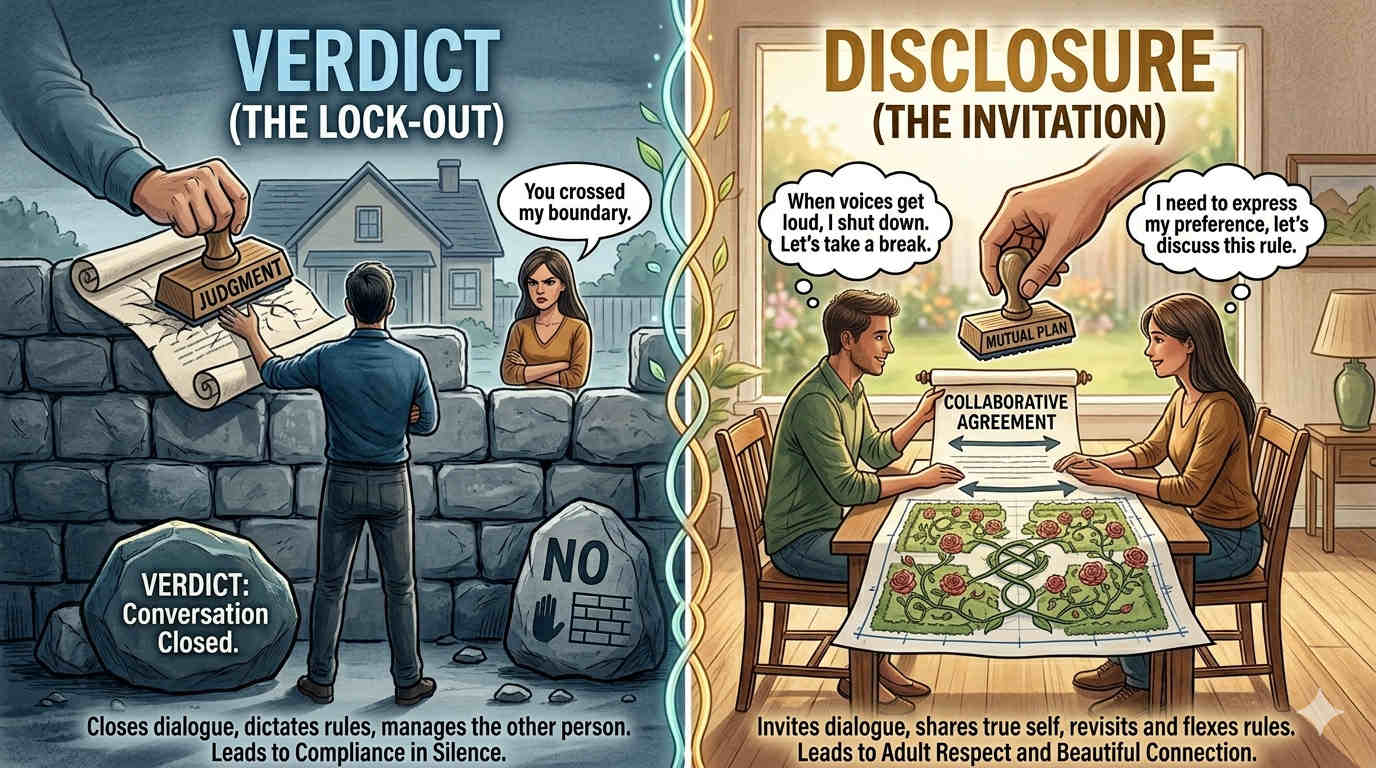
Instead of “You have crossed my boundary!” try “I’m not in a place to hear this right now. Can we come back to it?”
Instead of “I have a basic moral boundary and I leave the room if anyone yells,” try, “When voices get loud, I tend to get flooded and shut down. I need to take a step away, but I will be back in 30 minutes.”
The difference is disclosure instead of verdict. One invites the other person in, while the other locks them out. One says, here is something true about me that I want to share with you, while the other says, you have done something wrong and I am the judge.
Rules, named honestly, flex. Rules can be revisited on a different day, in a different mood, in a different season of life. They keep both people present, at the table, as equals.
“We are born with a need for attachment and a need for authenticity. Most of us, at some point, learn to abandon our authenticity in order to preserve our attachments.” ~~ Gabor Mate, MD
We are destroyed in community with others, and we are healed in community with others, in friendships, in relationships, where we can practice naming the truth about ourselves instead of having to protect ourselves from others, and learning that our needs are not weapons, and other people’s needs are not threats.
A Rose By Any Other Name
You are allowed to have rules, and so are the people around you allowed to have rules that often conflict with yours. Own your rules. Name them out loud. Express them to others, and listen to theirs. Put them on the table where both of you can actually see them.
That is what it means to be in relationship with others.
Adulting is harder than issuing verdicts and managing behaviors. It is also the only version of relating that grows both you, and others.
References
- “Authenticity Can Heal Trauma”, Gabor Maté, MD, December 11, 2022,
https://www.madinamerica.com/2022/12/authenticity-can-heal-trauma-dr-gabor-mate-md/ - “Choosing Between Authenticity and Attachment: What happens to siblings who can’t differentiate.”, Posted May 3, 2023,
https://www.psychologytoday.com/us/blog/brothers-sisters-strangers/202305/choosing-between-authenticity-and-attachment - “Did You Sacrifice Authenticity For Connection? How Our Biological Need For Safety Sabotages Our Ability To Be Ourselves.”, Joe Gibson, Nov 23, 2023,
https://medium.com/change-your-mind/did-you-sacrifice-authenticity-for-connection-47b10fe67c59 - “Brené Brown on Empathy”,
https://www.youtube.com/watch?v=1Evwgu369Jw - “Explaining DARVO: Deny, Attack, Reverse Victim & Offender: How abusers might use these strategies to blame the survivor”, Amanda Kippert, Nov 23, 2022,
https://www.domesticshelters.org/articles/identifying-abuse/explaining-darvo-deny-attack-reverse-victim-amp-offender - The Bible speaks about this too. In Ephesians 4, Paul writes about speaking truth to one another, not managing one another with declarations. The relational vision throughout the New Testament is mutual and interactive. Mutual vulnerability, mutual accountability, mutual repair. It is not a vision where one person’s emotional preferences are held as sacred and non negotiable while the other person learns to comply in silence.